SaaS financial modeling sounds complex, but it’s simpler than most founders think. The real challenge isn’t building models, it’s knowing which metrics matter and how they connect to drive growth. This guide breaks down SaaS financial modeling into practical steps that empower you to make smarter decisions about scaling, fundraising, and resource allocation. You’ll discover the core metrics that fuel accurate projections, learn how to build models tailored to subscription businesses, and explore automation tools that streamline the entire process. Whether you’re preparing for Series A or optimizing unit economics, mastering financial modeling transforms uncertainty into strategic clarity.
Table of Contents
- Understanding SaaS Financial Modeling And Its Strategic Value
- Key SaaS Metrics That Power Effective Financial Models
- Building Your SaaS Financial Model: Framework And Best Practices
- Leveraging Automation And Tools To Enhance SaaS Financial Modeling
- Optimize Your SaaS Financial Modeling With Expert Solutions
Key takeaways
| Point | Details |
|---|---|
| Financial modeling drives data-driven growth | SaaS models project revenue, costs, and cash flow to guide strategic decisions and reduce planning errors. |
| Core metrics fuel accurate projections | MRR, ARR, churn rate, CAC, and LTV form the foundation of reliable SaaS financial models. |
| Structured frameworks simplify model building | A step-by-step approach to data collection, assumptions, and validation ensures usable, actionable models. |
| Automation enhances efficiency and accuracy | Integrating dashboards and reporting tools cuts manual work and improves forecast reliability. |
| Models support fundraising and scaling | Investors demand clear financial projections that demonstrate growth potential and risk management. |
Understanding SaaS financial modeling and its strategic value
SaaS financial modeling projects revenues, expenses, and cash flows specific to subscription-based businesses. Unlike traditional companies that rely on one-time sales, SaaS businesses generate recurring revenue streams that require specialized forecasting techniques. Your model becomes the engine for scenario planning, helping you test different growth strategies before committing resources.
Why does this matter for your business? Financial models reveal when you’ll hit profitability, how much runway remains, and which customer segments deliver the highest returns. They’re essential for fundraising conversations because investors want proof you understand your unit economics and growth trajectory. SaaS financial modeling helps founders cut reporting errors by over 50%, making projections more reliable and decisions more confident.
Every SaaS model focuses on these core elements:
- Monthly and annual recurring revenue patterns
- Customer acquisition costs and payback periods
- Churn rates and retention dynamics
- Lifetime value calculations
- Cash burn and runway projections
Subscription businesses face unique complexity because revenue recognition spans months or years, not single transactions. Your customers might sign annual contracts but pay monthly, or prepay for multi-year deals. Churn compounds over time, affecting growth rates in ways that aren’t immediately obvious. These dynamics make SaaS fundamentally different from traditional business models.
Proper financial modeling transforms gut feelings into quantified strategies, letting you compare the impact of hiring another salesperson versus investing in product development.
Without accurate models, you’re flying blind. You might overspend on acquisition channels that never pay back, or underfund initiatives that could accelerate growth. Financial modeling gives you the clarity to allocate resources strategically and communicate your vision to stakeholders. For deeper insights on building robust SaaS financial reporting steps, explore proven frameworks that reduce errors and improve forecast accuracy.
Key SaaS metrics that power effective financial models
Your financial model is only as good as the metrics feeding it. SaaS businesses track fundamentally different KPIs than traditional companies, and understanding these metrics is non-negotiable for accurate forecasting.
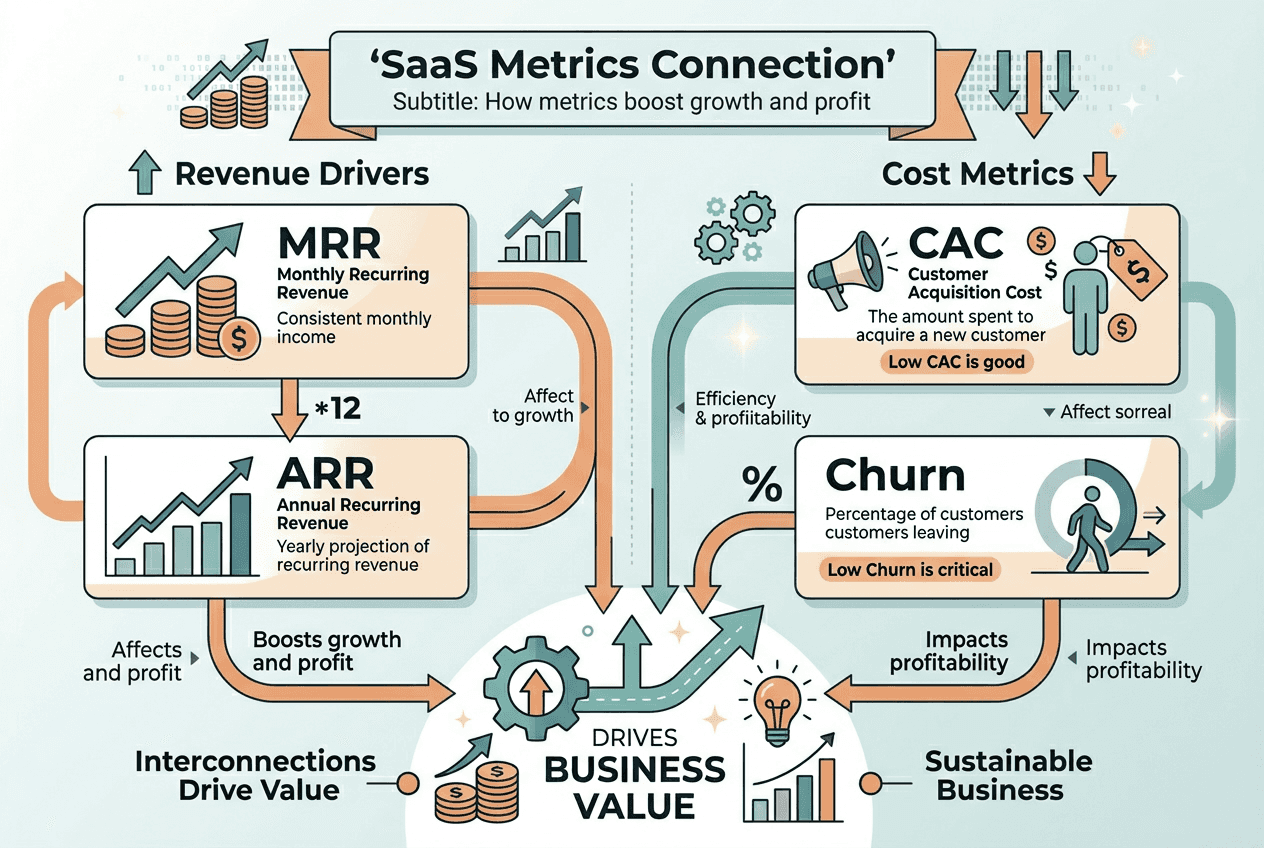
Monthly recurring revenue (MRR) measures predictable income generated each month from subscriptions. Annual recurring revenue (ARR) scales this to a yearly view, giving you a clearer picture of long-term growth. These metrics form the foundation of your revenue projections because they isolate recurring income from one-time fees or variable charges.
Churn rate tells you what percentage of customers cancel each month. A 5% monthly churn might sound manageable until you model it over 12 months and realize you’re losing half your customer base annually. High churn destroys growth because you’re constantly replacing lost revenue instead of building on existing accounts. Understanding metrics like MRR, ARR, churn, and CAC are fundamental for SaaS financial modeling accuracy helps you spot problems before they derail growth.
Customer acquisition cost (CAC) captures everything spent to land a new customer, from marketing campaigns to sales team salaries. CAC payback period shows how many months of revenue it takes to recover that investment. If your CAC payback exceeds 12 months, you’re burning cash faster than you’re generating returns, which limits scaling velocity.

Lifetime value (LTV) projects total profit from a customer relationship over its entire duration. The LTV to CAC ratio reveals whether your business model is sustainable. A healthy ratio sits above 3:1, meaning each customer generates three times what you spent acquiring them.
Here’s how these metrics compare:
| Metric | Definition | Formula | Business Impact |
|---|---|---|---|
| MRR | Monthly recurring revenue | Sum of all monthly subscriptions | Tracks short-term revenue health |
| ARR | Annual recurring revenue | MRR × 12 | Projects long-term growth trajectory |
| Churn Rate | Percentage of customers lost | (Customers lost / Total customers) × 100 | Measures retention and growth sustainability |
| CAC | Cost to acquire one customer | Total sales and marketing spend / New customers | Evaluates acquisition efficiency |
| LTV | Total customer profit over lifetime | (Average revenue per account × Gross margin) / Churn rate | Assesses long-term profitability |
These metrics interconnect in powerful ways. Lower churn increases LTV, which improves your LTV to CAC ratio, giving you more budget for aggressive growth. Higher MRR growth lets you invest in reducing CAC through better conversion funnels. Understanding these relationships transforms isolated numbers into a cohesive growth strategy.
Pro Tip: Track these metrics weekly during rapid growth phases and monthly once you reach stability. Regular updates catch trends early, letting you adjust strategies before small problems become major setbacks. Explore comprehensive guidance on SaaS key metrics guide and financial health indicators to deepen your understanding of what moves the needle.
Building your SaaS financial model: framework and best practices
Building a financial model feels overwhelming until you break it into clear steps. Start simple and add complexity only when needed. Here’s the framework that works for most SaaS businesses:
- Collect historical data on revenue, expenses, and customer metrics from the past 12-24 months.
- Define key assumptions about growth rates, churn, pricing changes, and hiring plans.
- Build your revenue model by projecting new customer acquisition, expansion revenue, and churn.
- Forecast expenses across categories like personnel, marketing, infrastructure, and overhead.
- Validate outcomes by stress-testing assumptions and comparing projections to industry benchmarks.
Your revenue model should segment income streams clearly. Separate new customer revenue from expansion revenue (upsells and cross-sells) and contraction revenue (downgrades). This granularity reveals which growth levers work best. Project churn realistically by analyzing historical patterns across customer segments, not just company-wide averages.
Structured financial models enable more reliable forecasting and risk management by forcing you to articulate assumptions explicitly. When you write down that you expect 10% monthly growth, you can test whether your marketing budget and sales capacity support that target.
Here’s how simple versus advanced modeling approaches compare:
| Approach | Pros | Cons | Best For |
|---|---|---|---|
| Simple Model | Quick to build, easy to update, focuses on core metrics | Limited scenario testing, less granular insights | Early-stage startups, quick projections |
| Advanced Model | Detailed segmentation, robust scenario analysis, investor-ready | Time-intensive, requires expertise, can overcomplicate | Growth-stage companies, fundraising, strategic planning |
Pro Tip: Start with a simple model that tracks MRR, churn, and CAC. Once you’re comfortable, layer in cohort analysis, sales pipeline forecasting, and detailed expense breakdowns. Complexity should serve clarity, not obscure it.
Testing multiple scenarios is critical. Model your base case (realistic expectations), best case (aggressive growth), and worst case (higher churn, slower acquisition). This range prepares you for different outcomes and helps you identify which variables have the biggest impact on success. If a 2% increase in churn devastates your projections, you know retention deserves immediate focus.
For practical implementation guidance, review resources on SaaS financial dashboards and comprehensive SaaS financial planning guide that walk through real-world modeling examples.
Leveraging automation and tools to enhance SaaS financial modeling
Manual financial modeling works until it doesn’t. Updating spreadsheets every month drains time you could spend on strategy. Automation transforms financial modeling from a monthly chore into a real-time decision support system.
Automating repetitive tasks like data syncing between your billing system, CRM, and accounting software eliminates errors and saves hours. Modern SaaS financial tools pull metrics automatically, calculate KPIs instantly, and generate reports without manual intervention. This shift lets you focus on interpreting results instead of compiling numbers.
Automation in SaaS finance drives smarter scaling and reduces manual errors, freeing your team to analyze trends rather than chase data. When your dashboard updates daily with fresh MRR, churn, and CAC figures, you spot problems immediately instead of weeks later during month-end close.
Key automation advantages include:
- Real-time visibility into financial and operational metrics
- Elimination of manual data entry and reconciliation errors
- Faster month-end close processes and reporting cycles
- Automated alerts when metrics drift outside target ranges
- Seamless integration across billing, accounting, and analytics platforms
Top SaaS financial software categories include dedicated financial dashboards that visualize KPIs, reporting tools that automate investor updates, and planning applications that model scenarios dynamically. Look for solutions that integrate with your existing tech stack, whether that’s Stripe for billing, QuickBooks for accounting, or Salesforce for CRM.
Automation doesn’t just save time, it transforms financial operations from reactive to proactive, letting you make decisions based on current data instead of outdated snapshots.
The right tools reduce your financial reporting cycle from days to hours. They catch discrepancies automatically, flag unusual patterns, and ensure your board decks always reflect the latest numbers. For executives juggling multiple priorities, automation is the difference between drowning in spreadsheets and driving strategic initiatives.
Explore how automation in SaaS finance accelerates growth and review SaaS financial reporting tools that deliver faster, more accurate insights. The investment in proper automation pays back quickly through time savings and better decision quality.
Optimize your SaaS financial modeling with expert solutions
Mastering financial modeling takes time most founders don’t have. You’re building product, closing deals, and managing teams. Meticq specializes in SaaS financial modeling and CFO advisory, bringing deep expertise in subscription business dynamics to help you scale smarter.
Our automation and reporting tools transform complex financial operations into streamlined workflows. We track the metrics that matter, build models tailored to your growth stage, and deliver insights that drive better decisions. Whether you need help constructing your first financial model or want to upgrade from spreadsheets to automated dashboards, we provide the expertise and technology to accelerate your financial maturity. Explore our resources on automation in SaaS finance, dive into our comprehensive SaaS financial planning guide, and discover strategies for scaling SaaS finance process that support efficient growth. Partnering with experts who understand SaaS economics lets you focus on what you do best while ensuring your financial foundation supports ambitious growth targets.
What is SaaS financial modeling?
What essential metrics should I track in SaaS financial modeling?
Track MRR, ARR, churn rate, CAC, CAC payback period, and LTV as your core metrics. These six numbers reveal revenue health, customer retention, acquisition efficiency, and long-term profitability. Add burn rate and runway if you’re pre-profitability to monitor cash position.
How often should I update and review my SaaS financial model?
Update your model monthly during steady growth and weekly during rapid scaling or fundraising. Monthly updates keep projections aligned with actual performance without overwhelming your team. Weekly reviews help you catch trends early when things change quickly, letting you adjust strategies before problems compound.
What common pitfalls should I avoid when building SaaS financial models?
Avoid overly optimistic growth assumptions that ignore market realities and capacity constraints. Don’t treat churn as static, it varies by customer segment and changes over time. Never build models without testing multiple scenarios, and resist adding complexity that obscures rather than clarifies key drivers. Keep assumptions documented and transparent so anyone reviewing your model understands the logic.
Can automation fully replace manual financial modeling in SaaS?
Automation handles data collection, calculations, and reporting brilliantly but can’t replace strategic judgment. You still need to set assumptions, interpret results, and decide which scenarios to model. Think of automation as eliminating the mechanical work so you can focus on analysis and decision-making. The best approach combines automated data pipelines with human insight on strategy.
How does financial modeling support fundraising and investor communications?
Investors demand clear projections showing how you’ll use their capital to drive growth and reach profitability. Your model demonstrates you understand unit economics, can forecast realistically, and have thought through different scenarios. Strong models build confidence by showing you’re data-driven and strategic, not just optimistic. They also help you answer tough questions about burn rate, scaling efficiency, and path to positive cash flow. For broader context on SaaS finance fundamentals, review this SaaS finance guide 2026 that covers essential concepts for founders and CFOs.