Juggling growth targets while drowning in spreadsheets feels familiar to many SaaS founders. Financial tasks pile up quickly, making it tough to get a clear picture of cash flow or recurring revenue without burning valuable hours. Defining automation in SaaS finance is no longer just about convenience—it creates space for smarter decisions, faster reporting, and less time spent on tedious work. This guide breaks down what true automation looks like, how it beats basic tools, and why it is reshaping modern SaaS financial management.
Table of Contents
- Defining Automation In SaaS Finance Today
- Core Types Of Automation And Tools Used
- Streamlining Recurring Billing And Metrics
- Redefining Financial Control And Error Reduction
- Risks, Challenges, And Best Practices For SaaS
Key Takeaways
| Point | Details |
|---|---|
| Embrace Automation | Implement automation to enhance financial efficiency, allowing the team to focus on strategic tasks instead of manual data entry. |
| Prioritize Pain Points | Start with automating the most time-consuming processes, such as invoice processing and bank reconciliation, to achieve quick wins. |
| Choose Integrated Tools | Select tools that seamlessly integrate with existing systems to minimize data silos and enhance workflow accuracy. |
| Mitigate Risks | Avoid over-automation and ensure data quality by centralizing information before implementing automated processes. |
Defining Automation in SaaS Finance Today
Automation in SaaS finance means using technology to handle repetitive financial tasks without manual intervention. Think of it as replacing hours of data entry, spreadsheet updates, and transaction reconciliation with systems that work around the clock.
For SaaS founders, this isn’t about replacing your finance team. It’s about freeing them from busywork so they focus on what actually moves the needle: analyzing cash flow, forecasting ARR, and spotting revenue patterns that drive growth decisions.
What Automation Actually Does
Robotic process automation and AI technologies can transform how your financial workflows operate, moving beyond simple data entry to intelligently organize and synthesize complex financial information. Here’s what gets automated in a modern SaaS finance setup:
- Invoice processing: Bills arrive, get matched to purchase orders, and route for approval automatically
- Expense categorization: Receipts are scanned, categorized by account, and flagged if they’re out of policy
- Bank reconciliation: Transactions match themselves to your books without you touching a spreadsheet
- Revenue recognition: Billings translate into recognized revenue based on SaaS-specific rules automatically
- Financial reporting: Monthly P&Ls, balance sheets, and SaaS metrics generate on a set schedule
- Payment processing: Vendor payments schedule themselves based on terms you’ve defined
The result? Your accounting team spends less time hunting down numbers and more time answering questions like “What’s our true CAC this quarter?” or “When do we hit cash flow positive?”
The Difference Between Tools and Real Automation
Here’s where most founders get confused. A spreadsheet with formulas isn’t automation. A tool that lets you manually upload files and click “process” isn’t automation either.
True automation means: Data flows from source to destination without someone touching it. When a customer pays via Stripe, that payment appears in your accounting system instantly. When an invoice goes out, it automatically creates a revenue line item.
Automation handles organizing financial data and enabling real-time complexity management that would be impossible to do manually. This matters for SaaS because your revenue changes every single day, and you need accurate numbers fast.
Why This Matters Right Now
You’re probably juggling growth with limited resources. Manual financial processes slow everything down. When data takes weeks to compile, your board meeting happens based on guesses, not facts.
Automation compresses that timeline. Instead of waiting for month-end close to see your metrics, you can pull accurate numbers on Wednesday and make decisions Thursday.
Automation doesn’t replace your financial thinking—it eliminates the data tedium that prevents you from doing it well.
Pro tip: Start by automating your highest-pain process first—usually invoice processing or bank reconciliation. Pick the task that eats the most time, fix it, then move to the next one. Small wins build momentum.
Core Types of Automation and Tools Used
Not all automation works the same way. Understanding the different types helps you pick the right tool for your specific financial pain point.
There are three main categories of automation in SaaS finance, each with different capabilities and complexity levels. Think of them as a progression from simple to intelligent.
The Three Layers of Automation
Rule-based automation handles straightforward, predictable tasks. If X happens, then do Y. These systems follow exact instructions with no deviation.
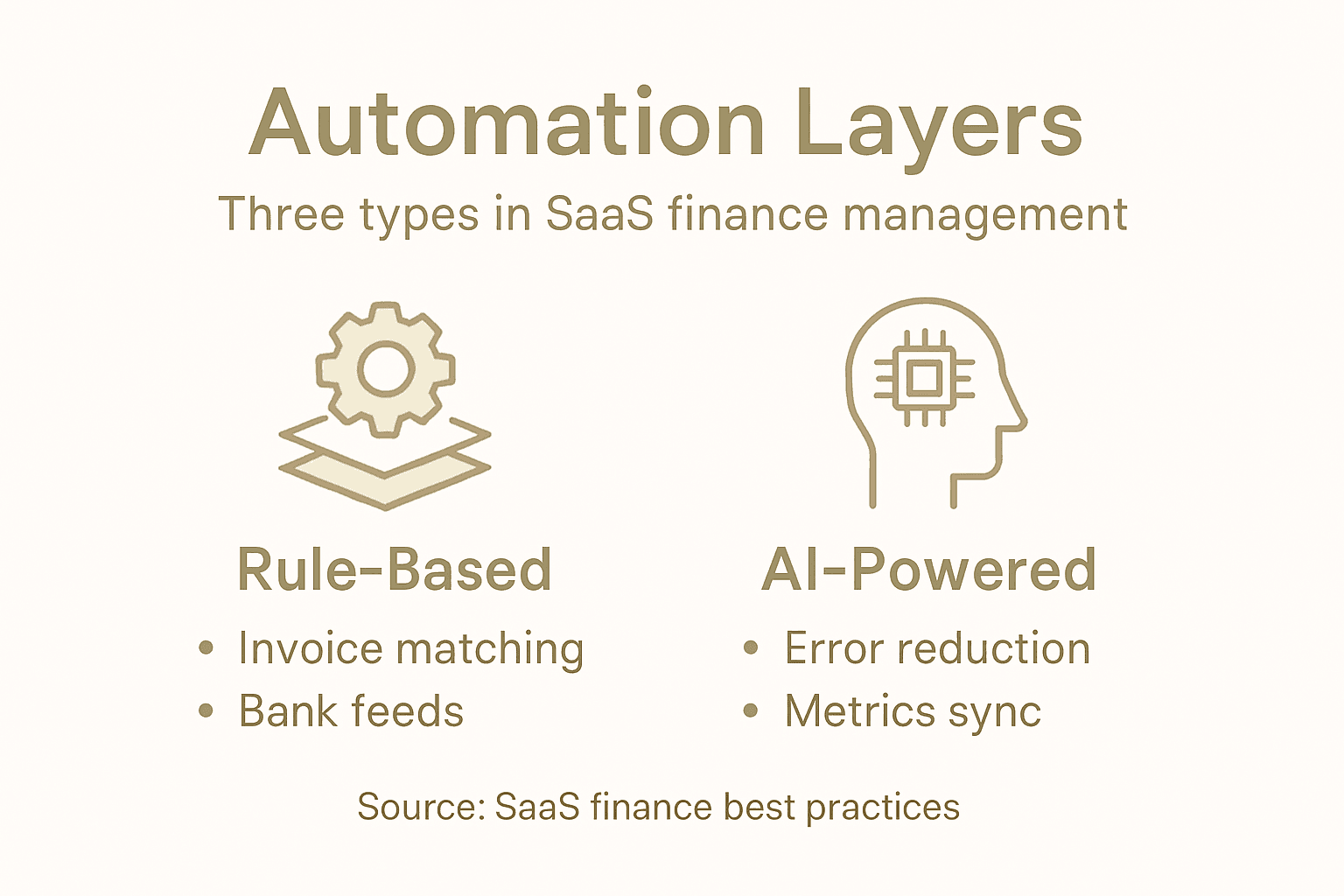
Intelligent automation uses machine learning to recognize patterns and adapt. It learns from your data and gets smarter over time, handling exceptions without human input.
AI-powered systems combine everything. They think through complex scenarios, make judgment calls, and continuously improve themselves. They’re the most powerful but also require the most setup.
Robotic process automation technologies excel at automating routine, rule-based financial tasks like invoice matching, payment processing, and compliance checks, delivering measurable improvements in efficiency and accuracy that directly impact your bottom line.
Here’s how the three layers of automation compare in SaaS finance:
| Layer Type | Complexity Level | Typical Use Cases | Business Impact |
|---|---|---|---|
| Rule-based | Simple | Invoice matching, compliance | Reduces routine manual tasks |
| Intelligent | Moderate | Bank reconciliation, expense review | Adapts to exceptions and patterns |
| AI-powered | Advanced | Revenue recognition, forecasting | Enables decision-ready analytics |
What You’re Actually Using
When you implement automation tools for SaaS finance, you’re typically combining multiple types:
- Invoice processing platforms: Rule-based automation with intelligent recognition of vendor names, amounts, and account codes
- Bank reconciliation software: Intelligent automation that learns which transactions match and flags unusual activity
- Revenue recognition engines: AI-powered systems that understand your billing model and recognize revenue automatically
- Expense management tools: Rule-based automation with intelligent policy enforcement and approval routing
- Financial reporting systems: All three layers working together to pull, organize, and present data
The best SaaS finance stacks combine these tools so data flows automatically from source to analysis without manual handoffs.
Picking the Right Tool for Your Stage
Early-stage founders don’t need enterprise-grade AI. You need tools that eliminate obvious friction without overcomplicating things.
Start with tools that handle your highest-volume, lowest-complexity tasks first. This usually means invoice processing and bank reconciliation. As you grow, layer in more sophisticated tools that handle classifications and automation across your entire finance workflow.
The key is choosing platforms that talk to each other. Your invoicing tool should feed directly into your accounting system. Your bank feeds automatically to reconciliation. Your accounting system generates your reports.
Pick tools that reduce manual touchpoints, not tools that replace your thinking. Automation should free your time for strategy, not create new busywork.
Many founders waste money on tools that sit unused because they require too much manual setup or don’t integrate with their existing stack. Avoid that trap.
Pro tip: Before buying any automation tool, map your three most painful financial workflows. Pick the one causing the most time waste and find a tool that solves just that problem. Once it’s working smoothly, expand from there.
Streamlining Recurring Billing and Metrics
Recurring billing is where SaaS finance gets complicated. Unlike traditional businesses that invoice once and move on, you’re managing subscriptions, prorations, upgrades, downgrades, and churn every single day.

Without automation, tracking this manually is chaos. You’re juggling multiple billing events, trying to match them to revenue recognition rules, and hoping your metrics add up at month-end. They usually don’t.
Why Recurring Billing Breaks Manual Processes
Your billing system generates transactions constantly. A customer signs up on the 15th of the month. Another upgrades mid-cycle. A third cancels and should get a prorated refund. A fourth changes plans and you need to recognize revenue correctly.
AI and machine learning streamline recurring billing accuracy by automating the capture, calculation, and recording of these events, reducing manual errors that compound over time and distort your financial picture.
Each event creates multiple financial entries across your books. Without automation, your billing team enters data manually, your accountant re-enters it, and your CFO has to spot-check everything. That’s three chances for errors to creep in.
Automation eliminates the re-entry. One source of truth feeds directly into your accounting system.
What Actually Gets Automated
When you automate recurring billing, you’re automating several interconnected processes:
- Invoice generation: Automatically create invoices based on billing events and send them on schedule
- Revenue recognition: Record revenue when it’s earned according to ASC 606 rules, not when you invoice
- Churn tracking: Flag cancelled subscriptions and adjust metrics in real-time
- Proration calculations: Automatically calculate refunds or credits for mid-cycle changes
- Tax calculation: Apply correct tax rates based on customer location
- Payment posting: Match incoming payments to invoices automatically
- Metric calculation: Pull billing data and calculate ARR, MRR, NRR, and churn without manual compilation
The result is that your billing data flows straight into your financial reporting without human intervention.
The Metrics Connection
Here’s the critical part: Automating data integration across billing, CRM, and accounting systems gives you real-time visibility into the metrics that actually matter for funding conversations and growth decisions.
When your billing system talks directly to your accounting software, you can pull accurate ARR, customer acquisition cost, and net revenue retention numbers on demand. No waiting for month-end. No spreadsheets. No guessing.
This matters because your investors want these numbers. Your board wants them. And you need them to make smart growth decisions.
Recurring billing automation doesn’t just clean up your accounting—it transforms billing data into actionable business intelligence.
Many founders think “automation” means just moving invoices around faster. Real automation means your billing system becomes your financial reporting system.
Pro tip: Connect your billing platform directly to your accounting software, not to a middle-layer tool. Fewer handoffs mean faster, more accurate data. Check integration options before committing to any new billing system.
Redefining Financial Control and Error Reduction
Manual financial processes create blind spots. When people handle data repeatedly, errors compound silently. A misplaced decimal. A transaction entered twice. A revenue entry in the wrong month. None of these feels catastrophic alone, but together they distort everything.
Automation eliminates the manual steps where errors hide. It creates consistency, traceability, and accuracy that no human team can match at scale.
Where Manual Errors Creep In
Every time data changes hands, the risk of error increases. Your billing system generates a transaction. Your accountant pulls that data into a spreadsheet. Your CFO spot-checks it. That’s three opportunities for mistakes.
Common errors include duplicate entries, miscategorized transactions, reversed amounts, and timing mismatches between when revenue occurs and when you record it.
Robotic process automation reduces errors through the automation of repetitive, high-volume financial tasks, ensuring consistent application of rules across thousands of transactions and removing the human variability that causes reconciliation nightmares.
When automation handles these tasks, the same rules apply every single time. No variation. No missed steps. No human judgment calls that later need reversal.
The Control Architecture
Automation doesn’t weaken financial controls. It strengthens them by creating audit trails and enforcing rules consistently.
Here’s what better control looks like:
- Rule enforcement: Systems follow the same logic every transaction, with no exceptions or workarounds
- Audit trails: Every action is logged with timestamps and user attribution, creating complete visibility
- Exception flagging: Unusual transactions automatically route to review rather than processing silently
- Segregation of duties: Automation enforces separation between authorization, processing, and reconciliation
- Real-time monitoring: You see what’s happening as it happens, not weeks later during month-end close
- Compliance tracking: Tax, revenue recognition, and regulatory rules apply automatically
Traditional financial control relies on people checking people’s work. Automation-driven control relies on systems enforcing rules.
The Measurable Impact
Intelligent automation enhances financial accuracy and compliance through rule-based and AI-driven systems that reduce manual entry errors, tighten controls, and ensure consistent application of financial policies across your organization.
When you implement automation, you typically see these outcomes within the first quarter:
- Manual data entry errors drop by 80-95 percent
- Month-end close time shrinks from 10-15 days to 3-5 days
- Reconciliation issues that used to take days to track down disappear entirely
- Your accounting team spends less time chasing numbers and more time analyzing them
Automation doesn’t replace financial controls. It makes controls actually work at the scale your business demands.
This matters because as you scale, hiring more accountants just adds more complexity and more potential for error. Automation scales without adding headcount.
Pro tip: Start by automating processes with clear rules and high transaction volume, like invoice matching or bank reconciliation. These show the fastest payoff in error reduction and build confidence for automating more complex workflows later.
Risks, Challenges, and Best Practices For SaaS
Automation isn’t a magic button you press and forget. It creates new complexities alongside the problems it solves. Understanding these risks and challenges helps you avoid expensive mistakes and implement automation in ways that actually stick.
The biggest risk isn’t technology failure. It’s adopting automation without changing how your team works.
The Real Risks
Over-automation is tempting. You automate everything at once, processes break in ways you didn’t anticipate, and your team loses trust in the system entirely.
Data quality issues compound automatically. If your billing system has bad data, automation just spreads that bad data faster and wider. Garbage in, garbage out.
Integration failures happen when systems don’t talk to each other properly. You end up with isolated automated processes that create more manual work than they eliminate.
Process stagnation occurs when you automate a broken process. The process gets faster but stays broken. You’ve just made your problem more efficient.
Scaling automation in SaaS finance requires overcoming technological, organizational, and data integration challenges through continuous improvement cycles and cross-functional collaboration to ensure automation actually improves outcomes rather than amplifying existing problems.
Common Implementation Challenges
Most founders face these obstacles when they start automating:
- Data silos: Billing data lives in one system, accounting in another, and they don’t connect
- Legacy system friction: Your existing tools weren’t designed to integrate with modern automation platforms
- Team resistance: People worry automation means job cuts, so they slow adoption or work around it
- Hidden process complexity: What looks simple on the surface has exceptions and edge cases everywhere
- Compliance uncertainty: You’re not sure if automation will handle your specific revenue recognition or tax requirements correctly
These aren’t technical problems. They’re organizational and process problems that no tool solves automatically.
Key risks and challenges to consider before automating SaaS finance processes:
| Risk or Challenge | Potential Consequence | Strategic Solution |
|---|---|---|
| Over-automation | Broken processes, mistrust | Automate one workflow at a time |
| Data quality issues | Compounded reporting errors | Centralize data before automating |
| Integration failure | Manual work increases | Choose tools with native integrations |
| Team resistance | Slow adoption, workarounds | Train and involve staff in changes |
| Compliance uncertainty | Regulatory gaps | Test automation against requirements |
Best Practices That Actually Work
Successful SaaS founders approach automation methodically, not frantically:
- Start small: Pick one painful process, automate it completely, and get it working before moving on
- Centralize data: Build a single source of truth before automating anything, so automation pulls from clean data
- Test thoroughly: Run new automation in parallel with manual processes for a month to catch failures before they matter
- Train your team: Help people understand why automation exists and how it changes their work, not just that it’s happening
- Build for integration: Choose tools that connect natively with your existing stack, not tools that require workarounds
Adopting automation incrementally with centralized data and cross-functional collaboration minimizes resistance and maximizes adoption success in SaaS finance environments.
The teams that win at automation view it as a continuous improvement process, not a one-time implementation project.
Automation fails when you treat it as a technology problem. It succeeds when you treat it as a people and process problem that technology enables.
Pro tip: Create an automation rollback plan for every new implementation. If something breaks, you need a way to revert to manual processes immediately. This safety net lets your team adopt automation with confidence instead of fear.
Scale Your SaaS Finance with Smarter Automation Today
The challenge of managing repetitive financial workflows while scaling your SaaS business demands more than simple tools — it requires intelligent automation that delivers accuracy, real-time insights, and error reduction. This article highlights how automation frees your team from manual tasks like invoice matching and recurring billing so you can focus on strategic financial decisions with confidence. If you struggle with fragmented data, slow reporting cycles, or inconsistent metrics like ARR and churn, embracing a tailored solution can streamline your entire finance operation.
Discover how Meticq acts as your strategic financial partner by combining expert SaaS CFO-level guidance with an automated platform designed specifically for SaaS metrics such as CAC, NRR, and payback period. Start by learning the foundational concepts with SaaS Metrics 101 Archives – Meticq – SaaS CFO. Then explore how automation can become your strength instead of a complication. Take the first step to replace manual busywork with clarity and control. Visit Meticq now to transform your SaaS finance workflows and scale smarter.
Frequently Asked Questions
What is automation in SaaS finance?
Automation in SaaS finance refers to using technology to handle repetitive financial tasks without manual intervention, allowing finance teams to focus on more strategic activities like cash flow analysis and forecasting.
How does automation improve financial reporting in SaaS companies?
Automation streamlines the financial reporting process by automatically generating monthly profit and loss statements, balance sheets, and key SaaS metrics, providing accurate data quickly without manual compilation.
What are the different types of automation tools available for SaaS finance?
The main categories of automation tools for SaaS finance include rule-based automation, intelligent automation, and AI-powered systems, each varying in complexity and capability, from basic task handling to advanced decision-making.
Why is automating recurring billing important for SaaS businesses?
Automating recurring billing is crucial for SaaS businesses because it ensures accurate tracking of subscriptions, prorations, upgrades, and cancellations, minimizing manual errors and providing real-time visibility into essential financial metrics.