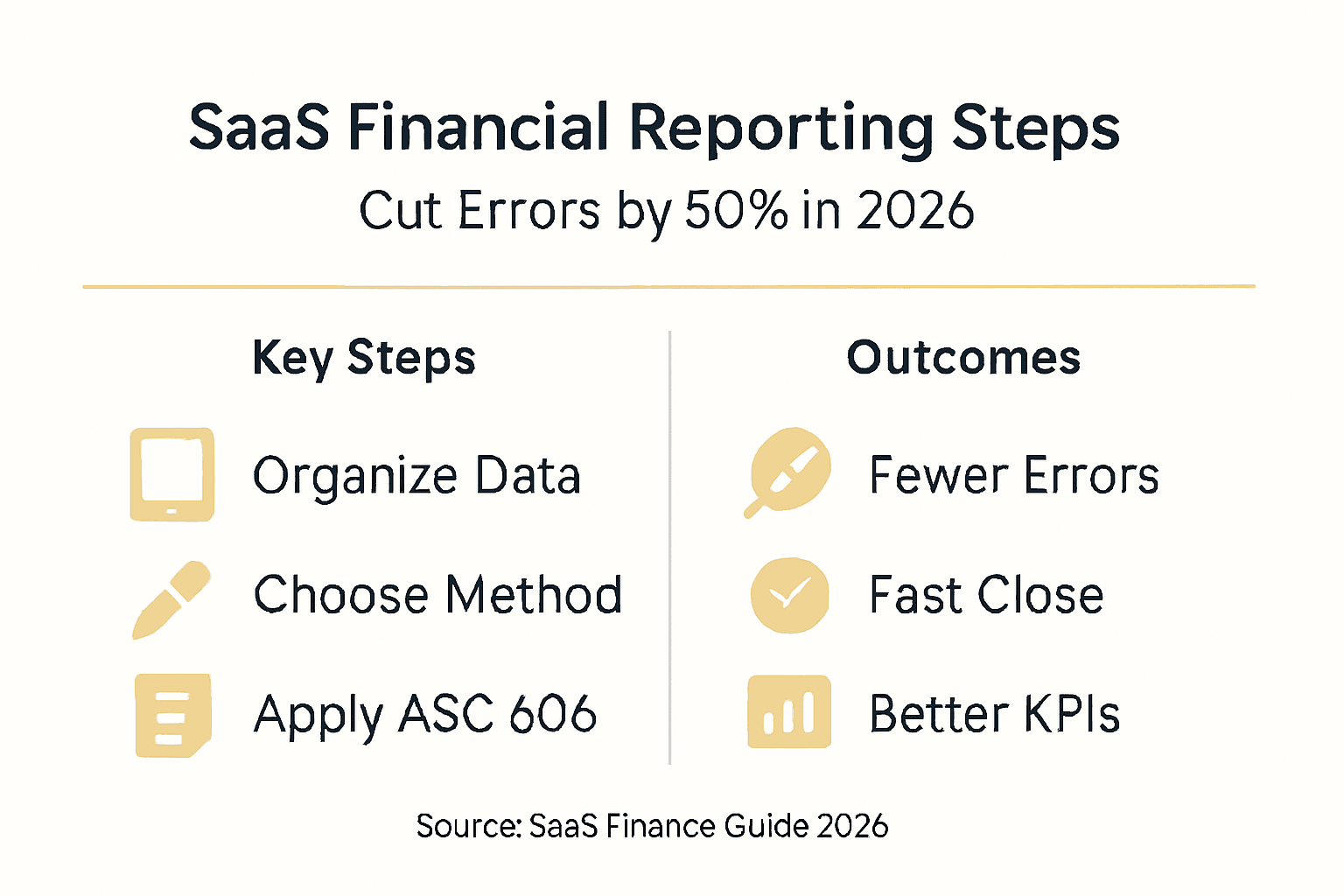
Messy financial reporting destroys trust fast. Up to 50% of SaaS startups lose investor value due to incorrect revenue recognition and deferred revenue mismanagement. SaaS founders face unique complexities with subscription revenue and deferred revenue that traditional accounting methods struggle to address. This guide delivers a practical, step by step framework to improve your 2026 reporting accuracy and compliance.
Table of Contents
- Prerequisites: What You Need Before Starting SaaS Financial Reporting
- Step 1: Organize Your SaaS Revenue Data and Contracts
- Step 2: Choose Accounting Methods Aligned With SaaS Needs
- Step 3: Apply ASC 606 Revenue Recognition Compliance
- Step 4: Manage Deferred Revenue and Liability Tracking
- Step 5: Build and Maintain SaaS Specific KPI Reports
- Step 6: Leverage Automation Tools and Integration
- Common Mistakes to Avoid in SaaS Financial Reporting
- Step 7: Troubleshoot and Continuous Improvement
- Expected Outcomes and Success Metrics
- Optimize Your SaaS Financial Reporting With Expert Solutions
Key Takeaways
| Point | Details |
|---|---|
| Revenue Recognition Compliance | ASC 606 requires monthly revenue recognition aligned with service delivery, not cash receipt timing. |
| Deferred Revenue Management | Track upfront payments as liabilities and reconcile monthly to prevent profit distortion. |
| KPI Automation Priority | Automate MRR, CAC, and NRR calculations first to reduce manual errors and reporting delays. |
| Process Efficiency Gains | Automation shortens month end close cycles by 30 to 50 percent while improving accuracy. |
Prerequisites: What You Need Before Starting SaaS Financial Reporting
Before executing SaaS financial reporting steps, ensure your foundation is solid. You need specific knowledge, tools, and data readiness to succeed.
First, grasp ASC 606 revenue recognition compliance basics. This standard governs how SaaS companies recognize subscription revenue over time. Second, confirm your SaaS accounting software integrates seamlessly with CRM and billing platforms. Data synchronization prevents costly reconciliation errors later.
Access to historic subscription and billing data matters critically. You cannot build accurate reports without clean past records. Define financial oversight roles clearly, assigning data ownership to specific team members. This prevents confusion during month end close cycles.
Finally, understand basic SaaS KPIs like MRR, ARR, CAC, and NRR. These metrics form the language of SaaS finance. Knowing how they interconnect helps you spot issues early.
- Master ASC 606 fundamentals for subscription revenue
- Ensure accounting, CRM, and billing systems integrate properly
- Secure complete access to historical subscription data
- Assign clear data ownership across finance team
- Define core SaaS KPI calculations consistently
Explore CFO tips for SaaS financial growth to strengthen your strategic foundation.
Step 1: Organize Your SaaS Revenue Data and Contracts
Clean data fuels accurate reporting. Start by cataloging every active customer contract with precise start dates, end dates, and pricing terms. Standardize data fields across all contracts to enable consistent analysis.
Separate revenue by distinct performance obligations per ASC 606 requirements. If your contract bundles software access with professional services, treat them as separate obligations. Document payment terms meticulously, including prepayments and billing frequency variations.
This upfront effort creates a clean foundation for later revenue recognition and KPI tracking. Messy contract data cascades errors through every downstream report.
- Catalog all active contracts with complete date and pricing details
- Standardize contract field naming conventions across systems
- Identify and separate multiple performance obligations within contracts
- Document payment terms including advance billing arrangements
- Validate data completeness before proceeding to recognition steps
Refer to the SaaS accounting checklist for comprehensive data organization guidance.
Step 2: Choose Accounting Methods Aligned with SaaS Needs
Your accounting method choice determines reporting reliability. Adopt accrual basis accounting exclusively for all revenue and expense recognition. This method matches revenue with the period services are delivered, not when cash changes hands.
Never mix cash and accrual methods. Inconsistencies here create audit nightmares and investor distrust. Ensure full compliance with GAAP and ASC 606 standards from day one.
Set clear written policies on cost capitalization timing and expense recognition rules. Document these policies thoroughly. Maintain consistent methods across all reporting periods to enable meaningful trend analysis.
- Use accrual accounting exclusively for all transactions
- Avoid mixing accounting methods across different revenue streams
- Document compliance frameworks referencing GAAP and ASC 606
- Create written policies for cost capitalization decisions
- Apply methods consistently period over period
Pro Tip: Document your accounting policy choices in a centralized finance manual that new team members can reference quickly.
Review the financial planning guide and SaaS accounting checklist for policy framework examples.
Step 3: Apply ASC 606 Revenue Recognition Compliance
ASC 606 provides a five step framework specifically designed for subscription business models. ASC 606 requires SaaS companies to recognize revenue monthly over the subscription period, even if payment arrives upfront.
Follow this structured approach:
- Identify contracts with customers and enumerate all performance obligations within each contract
- Determine the total transaction price including any variable consideration estimates
- Allocate transaction price fairly to each identified performance obligation based on standalone selling prices
- Recognize revenue incrementally each month as you deliver services over the subscription term
- Handle contract modifications promptly and update revenue schedules to reflect changes
Align revenue recognition timing strictly with service delivery, ignoring cash receipt timing entirely. This separation prevents common reporting errors that destroy investor confidence.
Explore types of SaaS finance to understand how recognition standards vary across financing models.
Step 4: Manage Deferred Revenue and Liability Tracking
Cash collected before services are delivered creates a liability, not immediate revenue. Record upfront payments as deferred revenue on your balance sheet. This liability decreases monthly as you recognize earned revenue.

Track deferred revenue balances carefully each month. Reconcile these balances with recognized revenue amounts to catch discrepancies early. Align recognition timing strictly with your actual service delivery schedule.
Regularly reconcile deferred revenue with cash flow forecasts. This practice prevents misstatements that distort profitability metrics. Ensure complete transparency of deferred revenue amounts in financial reports shared with investors.
- Record all advance payments as deferred revenue liabilities immediately
- Maintain detailed monthly tracking of deferred revenue balances
- Reconcile deferred amounts with revenue recognition schedules weekly
- Align recognition strictly with service delivery milestones
- Report deferred revenue prominently in investor communications
Check scaling SaaS finance processes for advanced reconciliation techniques.
Step 5: Build and Maintain SaaS Specific KPI Reports
Maintaining a clean monthly recurring revenue (MRR) schedule that breaks down new, expansion, contraction, and churn at the customer level improves revenue predictability dramatically. Construct granular MRR schedules showing these four components by customer and product.
Define and track critical SaaS KPIs consistently: CAC, LTV, NRR, burn rate, and payback period. Use these reports for operational management and building investor confidence. Maintain strict consistency in metric definitions to enable period over period comparability.
Review KPI reports monthly to detect trends and anomalies early. Automated alerts help catch unusual patterns before they escalate.
| KPI | Calculation | Target Benchmark |
|---|---|---|
| MRR Growth | New + Expansion – Contraction – Churn | 10 to 15 percent monthly |
| CAC Payback | CAC divided by Monthly Recurring Revenue per Customer | Under 12 months |
| NRR | Starting MRR + Expansion – Contraction – Churn divided by Starting MRR | Above 100 percent |
| Burn Rate | Monthly Operating Expenses minus Monthly Revenue | 18+ months runway |
- Build detailed MRR schedules tracking movement by customer
- Define SaaS KPI formulas consistently across all reports
- Automate KPI calculations to minimize manual entry errors
- Review reports monthly for trend identification
- Share KPI dashboards transparently with leadership and investors
Pro Tip: Automate KPI calculations completely to eliminate manual errors and save 10+ hours monthly.
Explore SaaS CFO tips and financial analytics for SaaS for advanced KPI frameworks.
Step 6: Leverage Automation Tools and Integration
Automation improves accuracy, shortens close cycles, and provides real time insights for SaaS financial reporting. Adopt SaaS focused accounting platforms with built in ASC 606 compliance features. These tools handle complex revenue recognition calculations automatically.
Automate deferred revenue tracking and KPI calculations completely. This eliminates manual spreadsheet errors that plague traditional finance teams. Integrate billing, CRM, and accounting platforms to synchronize data flow seamlessly.
Automation typically reduces month end close cycles by 30 to 50 percent while improving accuracy simultaneously.
| Approach | Manual Spreadsheets | Automated SaaS Platform |
|---|---|---|
| Close Cycle Time | 10 to 15 days | 3 to 5 days |
| Error Rate | 5 to 10 percent | Under 1 percent |
| Real Time Insights | No | Yes |
| ASC 606 Compliance | Manual complex | Automated built in |
| Scalability | Limited | High |
- Adopt accounting software designed specifically for SaaS models
- Automate all deferred revenue and KPI calculations
- Integrate billing systems directly with accounting platforms
- Target 30 to 50 percent reduction in close cycle duration
- Prioritize tools offering scalability as revenue grows
Pro Tip: Choose automation tools offering intuitive interfaces that non technical team members can use confidently without extensive training.
Learn more about automation in SaaS finance and managing SaaS growth strategies.
Common Mistakes to Avoid in SaaS Financial Reporting
Common SaaS financial reporting failures include incomplete MRR schedules, unclear expansion and contraction data, and lack of consistent definitions, severely harming valuation. Mixing cash and accrual accounting creates immediate audit red flags.
Maintain a complete, auditable MRR schedule detailing all revenue drivers at the customer level. Track deferred revenue meticulously to avoid misstating profitability. Prevent disconnected financial statements by ensuring all reports reconcile properly.
Implement automation aggressively to reduce manual errors and reporting delays. Regularly review and update financial processes to maintain ongoing compliance and accuracy.
- Never mix cash and accrual accounting methods within reporting
- Build comprehensive MRR schedules showing all movement components
- Track deferred revenue consistently every reporting period
- Ensure all financial statements reconcile and interconnect properly
- Use automation to eliminate manual calculation errors
- Review processes quarterly for continuous improvement opportunities
Consult the SaaS accounting checklist, SaaS finance trends 2026, and cut CAC payback guide for mistake prevention strategies.
Step 7: Troubleshoot and Continuous Improvement
Financial reporting accuracy demands ongoing refinement as your business scales. Regularly reconcile deferred revenue with MRR schedules and cash flow projections. These cross checks catch errors before they compound.
Utilize fractional CFO services or automated oversight tools for expert financial review. Address data discrepancies immediately when discovered. Update KPI definitions and reporting frameworks as your SaaS business model evolves.
Establish a culture prioritizing continuous financial process improvement. Document all fixes and process changes thoroughly for audit readiness.
- Reconcile deferred revenue with MRR and cash weekly
- Engage fractional CFO expertise for quarterly reviews
- Investigate and resolve discrepancies within 48 hours
- Update reporting frameworks as business complexity increases
- Document all process improvements for audit trails
- Schedule quarterly process retrospectives with finance team
Review scaling SaaS finance process for continuous improvement frameworks.
Expected Outcomes and Success Metrics
Successful implementation delivers measurable improvements across reporting quality and efficiency. Revenue should be recognized 100 percent in line with ASC 606 monthly standards. Financial reports should be completed within 7 days after period close consistently.
MRR schedules become detailed, reconciled, audit ready, and transparent. Automation typically reduces month end close cycles by 30 to 50 percent. Improved reporting accuracy builds investor confidence and supports stronger valuation outcomes.
| Success Metric | Target Outcome | Measurement Frequency |
|---|---|---|
| ASC 606 Compliance | 100 percent monthly recognition accuracy | Monthly audit |
| Close Cycle Duration | Under 7 days post period end | Monthly tracking |
| MRR Schedule Quality | Fully reconciled and audit ready | Monthly review |
| Process Efficiency | 30 to 50 percent cycle time reduction | Quarterly benchmark |
| Investor Confidence | Improved due diligence feedback | Per fundraising round |
Explore scaling SaaS financial workflows for outcome optimization strategies.
Optimize Your SaaS Financial Reporting with Expert Solutions
Mastering SaaS financial reporting requires both expertise and the right tools. Strategic automation combined with CFO level guidance transforms complex reporting challenges into competitive advantages. Scalable financial management practices enable smarter growth decisions backed by accurate, real time data.
Discover proven frameworks and automation solutions designed specifically for SaaS founders. Explore SaaS CFO tips, scaling SaaS finance process, and automation in SaaS finance to accelerate your financial operations and drive sustainable growth.
FAQ
What is the biggest common mistake SaaS founders make in financial reporting?
Mixing cash and accrual accounting methods creates dangerous inconsistencies and audit risks. This represents the most common and damaging mistake in SaaS reporting. Strictly adopting accrual accounting aligned with ASC 606 ensures accurate, compliant financial statements. Review the SaaS accounting checklist for method selection guidance.
How often should SaaS companies reconcile deferred revenue with cash flow?
SaaS companies should reconcile deferred revenue monthly to align revenue recognition with actual cash flow patterns. This prevents profit distortion caused by timing mismatches. Regular monthly reconciliation supports timely, accurate financial reporting. Explore scaling SaaS finance process for reconciliation best practices.
What SaaS KPIs should founders automate first for better financial insights?
Automate Monthly Recurring Revenue, Customer Acquisition Cost, and Net Revenue Retention calculations first. These three KPIs provide critical real time insight into business health and revenue trends. Automation eliminates manual errors and reporting delays that slow decision making. Learn more about financial analytics importance for KPI prioritization.
How does ASC 606 compliance specifically impact SaaS revenue recognition?
ASC 606 requires SaaS companies to recognize subscription revenue monthly over the service delivery period, regardless of payment timing. This means upfront annual payments must be recognized incrementally each month as services are delivered. The standard prevents premature revenue recognition that distorts profitability. Compliance ensures financial statements accurately reflect business performance.
Can small SaaS startups benefit from financial reporting automation immediately?
Yes, even early stage SaaS startups gain immediate benefits from automation. Automated tools eliminate manual errors from day one and establish scalable processes that grow with the business. Early automation prevents the need for painful process overhauls later. Starting with automated workflows saves time and reduces costs compared to retrofitting manual systems.
Recommended
- 6 Steps to Build a Powerful SaaS Accounting Checklist
- SaaS Financial Planning Guide: Cut CAC Payback to 12 Months
- Scaling SaaS Finance Process for Efficient Growth
- 7 Essential SaaS CFO Tips for Smarter Financial Growth
- Empowering Customer Support Teams to Fuel Profit Growth
- Data Pre-Processing: Powering Model Accuracy and Performance – Dot Data Labs – High-Quality Data for Training AI Models