Many SaaS founders mistakenly inflate ARR by including one-time fees, risking flawed financial decisions and investor credibility. Annual Recurring Revenue (ARR) is the cornerstone of SaaS financial clarity, yet confusion around its proper calculation and strategic use persists. This guide explains ARR’s definition, accurate calculation methods, common pitfalls, and how combining ARR with complementary KPIs drives smarter growth decisions in 2026.
Table of Contents
- Understanding ARR: Definition And Calculation
- Why ARR Matters: Strategic Importance For SaaS Growth
- Common Misconceptions And Pitfalls Around ARR
- ARR Versus Related Metrics: MRR, Bookings, And Beyond
- Practical Applications: Automating ARR Tracking And Decision Making
- Integrating ARR With Other SaaS KPIs For Financial Clarity
- Summary And Next Steps For SaaS Founders
- Enhance Your SaaS Finance With Meticq Solutions
Key takeaways
| Point | Details |
|---|---|
| ARR captures annual recurring revenue | Excludes one-time fees, professional services, and non-recurring items for accuracy. |
| Essential for planning and valuation | Investors use ARR multiples (5x to 10x) to value SaaS businesses and forecast growth. |
| Common errors distort financial health | Confusing ARR with bookings or gross revenue leads to cash flow misalignment and reporting mistakes. |
| Combine with other SaaS KPIs | Pairing ARR with CAC, LTV, churn, and NRR provides comprehensive financial insight. |
| Automation improves accuracy | Automated ARR tracking reduces manual errors and speeds up decision-making processes. |
Understanding ARR: definition and calculation
ARR represents the annualized value of recurring subscription revenue your SaaS business expects to receive. It excludes one-time setup fees, professional services, and non-recurring charges. This metric provides a stable baseline for financial planning, investor communication, and growth forecasting.
Calculate ARR by annualizing your net Monthly Recurring Revenue (MRR) after adjusting for customer churn, downgrades, and expansions. While multiplying MRR by 12 offers a quick approximation, accurate ARR requires revenue adjustments throughout the year. Excluding non-recurring fees can adjust ARR by 10 to 30% in many SaaS businesses, significantly impacting valuation and planning accuracy.
To calculate ARR correctly:
- Start with total subscription revenue from active contracts
- Annualize monthly or quarterly contracts to yearly equivalents
- Subtract revenue lost to churn and downgrades
- Add revenue from customer expansions and upsells
- Exclude professional services, implementation fees, and one-time charges
Pro Tip: Separate recurring subscription revenue from professional services revenue in your accounting system from day one. This clean separation prevents ARR inflation and builds investor confidence. Review your SaaS accounting checklist to establish proper revenue classification practices.
Maintaining clear boundaries between recurring and non-recurring revenue ensures your ARR reflects sustainable, predictable income. This distinction becomes critical when presenting financial health to investors who scrutinize revenue quality.
Why ARR matters: strategic importance for SaaS growth
ARR smooths monthly revenue volatility, providing a reliable foundation for long-term planning and budgeting. Unlike one-time sales that create unpredictable cash flow spikes, ARR represents committed, recurring income that supports strategic decision-making.

Investors value SaaS companies using ARR multiples, typically ranging from 5x to 10x depending on growth rate, market position, and profitability. A $2 million ARR company growing 100% year over year commands higher multiples than one growing 20%. This valuation method makes accurate ARR calculation essential for fundraising and exit planning.
ARR informs critical business decisions:
- Budget allocation for sales, marketing, and product development
- Hiring plans based on predictable revenue growth
- Capacity planning for infrastructure and support resources
- Cash flow forecasting and working capital management
- Strategic investments in customer success and retention programs
Pro Tip: Track ARR trends monthly alongside your growth rate. A consistent 10 to 15% monthly ARR increase signals healthy, sustainable growth. Sudden spikes or drops warrant immediate investigation into customer behavior, competitive threats, or product-market fit issues.
Your SaaS financial planning guide should integrate ARR as the primary revenue metric, connecting it to customer acquisition costs, lifetime value, and payback periods. This integration enables you to model growth scenarios, stress test assumptions, and communicate strategy clearly to stakeholders. When scaling SaaS finance processes, ARR serves as the north star metric that aligns operations, finance, and growth initiatives. Effective managing SaaS growth strategies depends on accurate ARR measurement and disciplined tracking.
Common misconceptions and pitfalls around ARR
ARR does not include one-time fees, implementation charges, or professional services revenue. These non-recurring items inflate ARR artificially, creating misleading growth signals and valuation errors. Investors and acquirers quickly identify inflated ARR during due diligence, damaging credibility.
ARR is not guaranteed future revenue. Customer churn, downgrades, and contract non-renewals reduce realized revenue below projected ARR. High churn rates expose ARR as unreliable, forcing downward revisions that shock stakeholders unprepared for the reality.
Multiplying MRR by 12 provides only an estimate. This shortcut ignores mid-year churn, seasonal variations, expansion revenue, and contract timing differences. Rigorous ARR calculation requires continuous adjustments for customer movements, not a simple annualization formula.
Confusing bookings with ARR causes serious cash flow and reporting problems:
- Bookings represent contract value signed, not revenue recognized
- Multi-year contracts create large bookings but spread ARR over contract terms
- Prepaid annual contracts appear as bookings immediately but convert to ARR gradually
- Mixing bookings and ARR in investor presentations signals financial immaturity
Pro Tip: Establish a monthly ARR reconciliation process. Compare beginning ARR, new customer additions, expansions, contractions, and churn to calculate ending ARR. This reconciliation catches errors early and builds confidence in your financial reporting.
Regularly review your ARR calculation methodology with your finance team and educate sales, customer success, and executive teams on proper definitions. Misalignment between teams creates reporting inconsistencies that erode trust. Leverage SaaS CFO tips essential for financial growth to establish discipline around ARR tracking and reporting standards.
ARR versus related metrics: MRR, bookings, and beyond
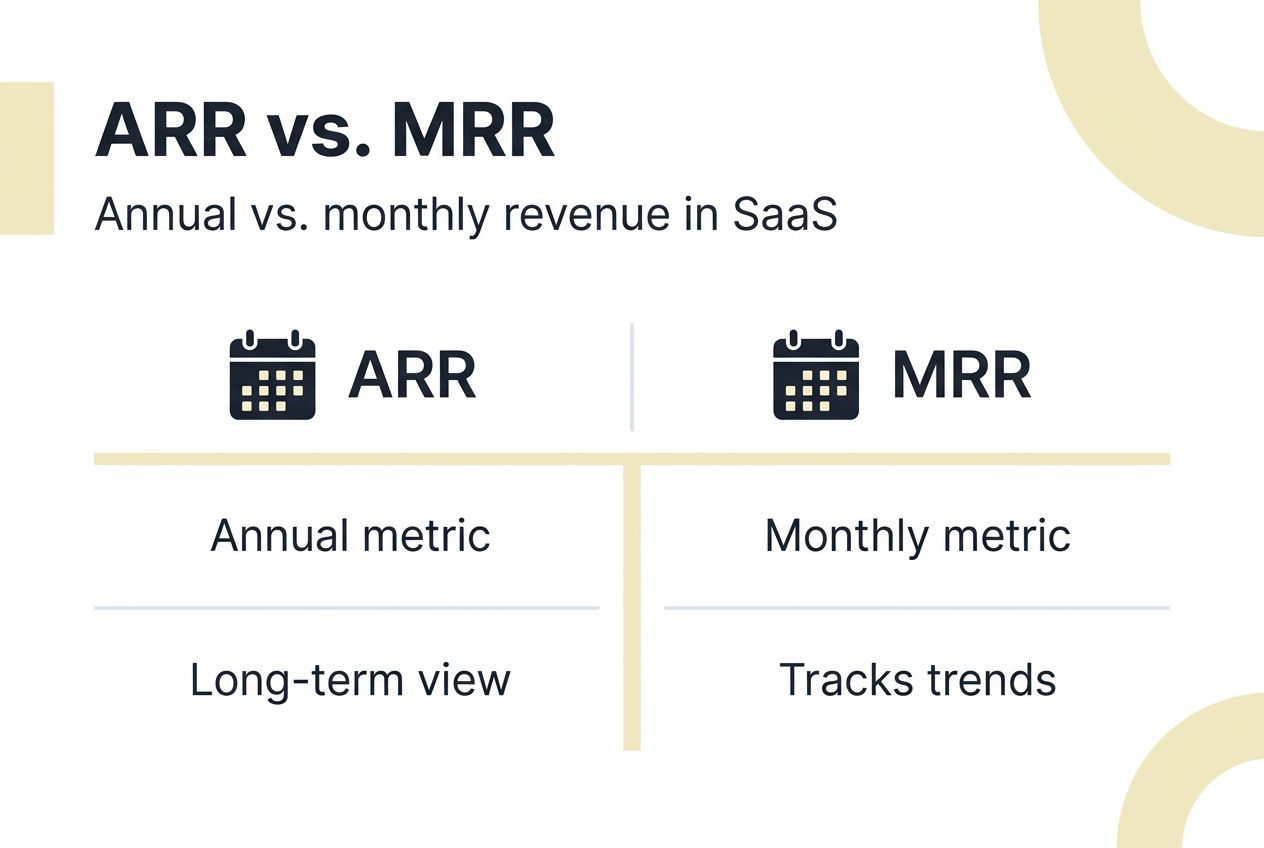
MRR provides monthly granularity on recurring revenue, capturing short-term trends and customer behavior changes. It offers operational visibility that annual metrics miss, enabling rapid response to churn spikes or expansion opportunities. ARR annualizes this recurring revenue, smoothing monthly volatility for strategic planning and investor communication.
Bookings report total contract value signed during a period, including multi-year commitments and one-time fees. While bookings indicate sales performance, they misalign with cash flow and revenue recognition timing. Cash flow timing mismatches in bookings can reach 30% monthly, creating planning challenges when bookings drive budgets instead of recognized revenue.
| Metric | Definition | Best Use Case | Limitation |
|---|---|---|---|
| ARR | Annualized recurring subscription revenue | Long-term planning, valuation, investor reporting | Ignores monthly volatility, doesn’t guarantee future revenue |
| MRR | Monthly recurring subscription revenue | Operational tracking, short-term trends, churn monitoring | Doesn’t capture annual commitments or strategic view |
| Bookings | Total contract value signed | Sales performance measurement, pipeline conversion | Misaligns with cash flow and revenue recognition timing |
| Revenue | Recognized income per accounting standards | Financial statements, compliance, tax reporting | Includes non-recurring items, complex recognition rules |
ARR best aligns with revenue recognition principles while filtering out non-recurring noise. This makes ARR the most reliable indicator of sustainable SaaS financial health. However, each metric serves distinct operational and communication roles.
Use these metrics complementarily for fuller financial insight. MRR tracks operational health, ARR guides strategic decisions, bookings measure sales effectiveness, and revenue satisfies accounting requirements. Understanding what SaaS metrics to measure when prevents confusion and ensures each stakeholder receives relevant information.
Practical applications: automating ARR tracking and decision making
Automation eliminates manual ARR calculation errors that plague spreadsheet-based approaches. Human errors in data entry, formula mistakes, and version control issues disappear when systems automatically track subscriptions, process changes, and calculate ARR in real time.
Automated ARR tracking delivers measurable improvements:
- Reduces finance team workload by 40 to 60% on recurring reporting tasks
- Improves forecasting accuracy through real-time data instead of lagging manual updates
- Enables daily or weekly ARR monitoring rather than monthly close cycles
- Supports instant scenario modeling for pricing changes or customer segments
- Facilitates faster board reporting and investor updates with current data
Real-time ARR visibility accelerates decision-making across your organization. Sales teams access up-to-date ARR targets and performance metrics. Customer success teams identify at-risk ARR and prioritize retention efforts. Executives model growth scenarios and adjust strategies based on current trends rather than stale data.
63% of high-growth SaaS companies attribute improved cash flow management to automated financial tracking systems, enabling faster strategic pivots and more accurate investor communications.
Automation supports better cash flow management by connecting ARR projections to billing cycles, payment processing, and accounts receivable. This integration reveals payment timing issues, identifies collection bottlenecks, and forecasts cash positions accurately. Explore automation in SaaS finance to understand implementation approaches and expected returns on automation investments.
Integrating ARR with other SaaS KPIs for financial clarity
ARR alone provides incomplete financial insight. Combining ARR with Customer Acquisition Cost (CAC) and Lifetime Value (LTV) reveals whether your growth is profitable or burning cash unsustainably. A healthy SaaS business maintains LTV to CAC ratios above 3:1, ensuring customer economics support growth investments.
Net Revenue Retention (NRR) together with ARR indicates growth sustainability. NRR above 100% means existing customers expand spending faster than churn erodes revenue, enabling growth without new customer acquisition. An ARR of $5 million with 120% NRR signals stronger health than $5 million ARR with 85% NRR, even if both grow at identical rates.
| KPI | Calculation | Target Range | Strategic Signal |
|---|---|---|---|
| ARR | Annualized recurring revenue | Growth dependent | Revenue scale and growth trajectory |
| CAC Payback | CAC divided by monthly revenue per customer | Under 12 months | Capital efficiency and growth sustainability |
| LTV:CAC Ratio | Customer lifetime value divided by acquisition cost | Above 3:1 | Customer profitability and unit economics |
| NRR | (Starting ARR + Expansion – Contraction – Churn) / Starting ARR | Above 100% | Existing customer growth and retention strength |
| Burn Multiple | Net burn divided by net new ARR | Below 1.5x | Capital efficiency in growth spending |
Monitoring churn rates refines ARR reliability and risk assessment. High churn rates (above 5% monthly for SMB-focused SaaS or 2% for enterprise) indicate product-market fit issues, support failures, or competitive threats. These signals prompt strategic adjustments before ARR erosion becomes severe.
Key integration practices:
- Review ARR, CAC, LTV, and NRR together in monthly executive meetings
- Set targets for each metric that align with growth stage and market position
- Track metric trends over rolling 12-month periods to identify patterns
- Segment metrics by customer cohort, plan tier, and acquisition channel
- Use integrated KPIs to guide hiring, marketing spend, and product investments
A holistic KPI framework prevents optimizing one metric at others’ expense. Aggressive customer acquisition might boost ARR growth while destroying CAC payback and burning excessive cash. Strict cost controls might improve burn multiple while sacrificing competitive position and ARR growth. Understanding what SaaS metrics to measure when ensures balanced financial management that supports sustainable scaling.
Summary and next steps for SaaS founders
ARR provides the foundation for understanding your SaaS company’s financial health and growth trajectory. Accurate ARR calculation, free from one-time fees and non-recurring revenue, builds investor credibility and supports reliable financial planning.
Implement these action steps immediately:
- Audit your current ARR calculation to identify and remove non-recurring revenue items that inflate your numbers artificially.
- Establish a monthly ARR reconciliation process tracking new customers, expansions, contractions, and churn to maintain accuracy.
- Integrate ARR with CAC, LTV, NRR, and other core SaaS metrics to create a comprehensive financial dashboard.
- Educate your entire team on proper ARR definitions to prevent reporting inconsistencies across departments.
- Consider automation tools that track ARR in real time and reduce manual calculation errors.
- Connect ARR trends to strategic decisions around hiring, marketing investment, and product development priorities.
Regularly adjust ARR calculations for customer movements throughout the year rather than relying on simple MRR annualization. This discipline catches problems early and provides accurate signals for course corrections.
Combine ARR insights with complementary KPIs to communicate complete financial health to investors, board members, and internal stakeholders. Single metrics tell incomplete stories while integrated KPI frameworks reveal true business performance and sustainability. Leverage your SaaS financial planning guide to build these connections systematically.
Enhance your SaaS finance with Meticq solutions
Accurate ARR tracking is just the beginning of financial clarity. Meticq offers specialized tools that automate ARR calculation, monitor critical SaaS KPIs in real time, and eliminate manual financial reporting errors that slow growth decisions.

Our platform transforms traditional bookkeeping into streamlined workflows that track CAC, NRR, LTV, burn rate, and payback period automatically. You gain CFO-level financial insight without the cost of a full-time executive. Access proven SaaS financial planning resources that help you cut CAC payback periods and accelerate growth. Implement automation in SaaS finance to reduce workload and improve forecast accuracy. Build scalable finance processes that support efficient growth from early stage through enterprise scale.
Frequently asked questions
What is ARR in SaaS?
ARR (Annual Recurring Revenue) measures the annualized value of recurring subscription revenue your SaaS business expects to receive. It excludes one-time fees, professional services, and implementation charges. ARR provides a stable metric for financial planning, investor valuation, and growth forecasting.
How is ARR calculated in SaaS?
Calculate ARR by annualizing net MRR after adjusting for customer expansions, downgrades, and churn. Start with total subscription revenue, exclude non-recurring items, and adjust for customer movements throughout the year. Avoid the simple MRR times 12 shortcut, which ignores important revenue adjustments.
What is the difference between ARR and MRR?
MRR measures monthly recurring revenue, providing operational granularity for tracking short-term trends. ARR annualizes recurring revenue to show yearly commitment and smooth monthly volatility. Use MRR for operational tracking and ARR for strategic planning and investor communication.
Why is ARR important for SaaS founders?
ARR enables accurate financial planning, supports investor valuations through ARR multiples, and guides scaling decisions. It provides a reliable measure of recurring revenue health that informs budgeting, hiring, and strategic investments. ARR is the foundation for communicating financial performance to stakeholders.
How can I avoid common ARR pitfalls?
Exclude one-time fees, implementation charges, and professional services from ARR calculations. Adjust ARR regularly for customer churn, downgrades, and expansions rather than using simple annualization formulas. Educate your team on proper ARR definitions and establish monthly reconciliation processes to maintain accuracy and prevent reporting errors.