Treating budgeting as a one-time yearly exercise is a mistake that costs SaaS founders dearly. Unlike traditional businesses, SaaS companies operate on recurring revenue models that demand continuous, metric-driven financial planning. Early-stage founders often lack SaaS-specific frameworks, leading to unpredictable cash flow and missed growth opportunities. This guide breaks down how integrating KPIs like CAC, LTV, and burn rate transforms budgeting from guesswork into a strategic advantage, while automation streamlines the entire process.
Table of Contents
- Introduction To SaaS Budgeting Basics
- Key SaaS Financial Metrics For Efficient Budgeting
- Understanding Burn Rate And Runway Management
- Leveraging Automation For Streamlined Budgeting
- Common Misconceptions In SaaS Budgeting
- Comparison Of SaaS Budgeting Frameworks
- Implementing A Practical SaaS Budget
- Optimize Your SaaS Budgeting With Meticq’s Expert Solutions
- Frequently Asked Questions About SaaS Budgeting Basics
Key Takeaways
| Point | Details |
|---|---|
| SaaS budgeting requires unique metrics | Integrate CAC, LTV, NRR, and burn rate for actionable financial insights instead of generic accounting. |
| Automation saves time and boosts accuracy | Financial automation tools reduce budgeting time by up to 70% while minimizing manual errors. |
| Zero-Based Budgeting cuts waste | SaaS-adapted Zero-Based Budgeting reduces unnecessary costs by roughly 18% in the first year. |
| Monthly updates maintain runway | Regular budget reviews aligned with SaaS KPIs prevent cash flow surprises and extend financial runway. |
| Ignoring SaaS KPIs creates instability | About 60% of early-stage SaaS startups without tailored budgeting face unpredictable cash flow within 18 months. |
Introduction to SaaS Budgeting Basics
SaaS budgeting fundamentally differs from traditional startup financial planning because of the recurring revenue model. Where product-based businesses focus on one-time sales margins, SaaS companies must track subscription metrics that reveal customer lifetime value and acquisition efficiency.
The financial planning approach for SaaS prioritizes KPIs like Customer Acquisition Cost, Lifetime Value, and Net Revenue Retention over traditional profit and loss statements. These metrics directly inform budget allocation decisions, from marketing spend to engineering headcount.
Early-stage SaaS founders face distinct challenges:
- Revenue volatility from monthly subscription churn fluctuations
- Long sales cycles requiring extended cash runway planning
- Complex cost structures mixing fixed infrastructure with variable customer success expenses
- Difficulty forecasting growth without historical SaaS benchmark data
- Manual data collection consuming time better spent on product development
Successful SaaS budgeting treats planning as a continuous process. You update forecasts monthly or quarterly based on actual performance against targets. Static annual budgets fail because SaaS metrics shift rapidly with customer behavior and market conditions.
Leveraging automation early in your budgeting workflow prevents the data chaos that plagues scaling companies. Financial analytics tools connect your subscription billing, CRM, and accounting systems to provide real-time visibility. This foundation supports the strategic B2B SaaS launch steps that drive sustainable growth.
Key SaaS Financial Metrics for Efficient Budgeting
Five core metrics determine whether your SaaS budget supports healthy growth or drains your runway prematurely.
Customer Acquisition Cost measures the total sales and marketing expense required to land one new customer. Calculate CAC by dividing total acquisition spending by new customers gained in that period. Healthy SaaS companies in 2026 target CAC payback periods under 12 months.
Lifetime Value represents the total gross profit expected from a customer relationship. The standard benchmark requires an LTV to CAC ratio of at least 3:1. Falling below this ratio signals you’re spending too much to acquire customers who don’t generate sufficient returns.
Net Revenue Retention tracks revenue changes from your existing customer base, including upgrades, downgrades, and churn. NRR above 100% means your current customers expand their spending faster than others leave. Top-performing SaaS companies achieve NRR of 120% or higher.
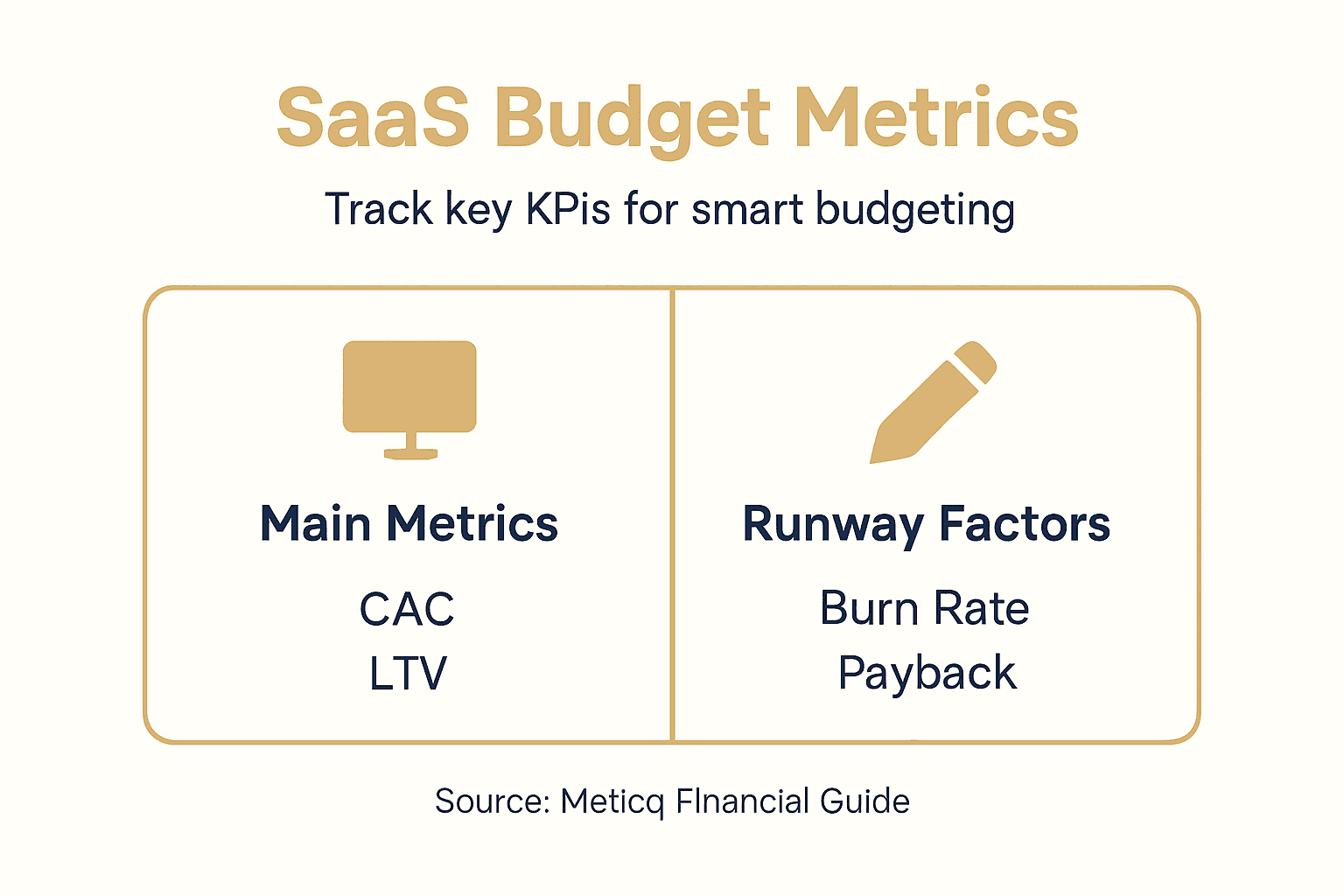
Burn rate is the single most critical metric determining the financial runway for early-stage SaaS startups, directly informing budget limits and spending prioritization. This monthly cash outflow figure dictates how aggressively you can invest in growth.

Payback period measures how many months of customer payments are needed to recover acquisition costs. Shorter payback periods free up cash faster for reinvestment. The target benchmark sits between 12 to 18 months for most B2B SaaS models.
| Metric | Healthy Range | Budget Impact |
|---|---|---|
| CAC Payback | Under 12 months | Determines maximum marketing spend sustainability |
| LTV:CAC Ratio | 3:1 or higher | Validates customer segment profitability for resource allocation |
| Net Revenue Retention | 110% or above | Influences customer success budget and expansion team sizing |
| Monthly Burn Rate | 12-18 month runway | Sets absolute spending limits across all departments |
| Gross Margin | 70% or higher | Defines pricing strategy and cost structure optimization needs |
Track these KPIs monthly to enable agile budget adjustments. Market conditions and customer behavior shift faster than quarterly reviews can catch. Cutting your CAC payback to under 12 months unlocks growth capital that would otherwise sit locked in customer acquisition.
Pro Tip: Build your budget around metric targets rather than department requests. Set CAC and LTV goals first, then allocate resources to hit those numbers.
Understanding your SaaS cost structure reveals which expenses scale with customers versus fixed infrastructure costs. This distinction guides smarter budget trade-offs between growth investments and margin protection. The comprehensive SaaS metrics framework provides detailed calculation methods for each KPI.
Understanding Burn Rate and Runway Management
Burn rate represents your monthly net cash outflow, the difference between revenue and total expenses. Runway calculates how many months your current cash balance lasts at the existing burn rate. These two metrics form the foundation of SaaS financial sustainability.
Early-stage SaaS startups should maintain a 12 to 18 month runway minimum. This buffer provides enough time to adjust strategy, reach the next funding milestone, or achieve profitability without desperate decisions. Falling below six months of runway forces reactive cuts that damage growth trajectory.
Calculate gross burn rate by summing all monthly operating expenses. Net burn rate subtracts monthly revenue from gross burn. Most investors and advisors focus on net burn because it shows the true cash consumption after accounting for customer payments.
Monitor burn rate weekly during high-growth phases or market uncertainty. Monthly tracking works for stable periods, but rapid hiring or major marketing campaigns require tighter oversight. Set alerts when burn rate increases 15% or more from baseline.
Burn rate is the single most critical metric determining the financial runway for early-stage SaaS startups, directly informing budget limits and spending prioritization. Every budget decision must reference current burn and projected runway impact.
Connect burn rate targets to your growth plan and fundraising timeline. If you’re raising a Series A in 12 months, maintain 18 months of runway to negotiate from strength. If bootstrapping to profitability, reduce burn rate monthly while protecting revenue-generating activities.
Common burn rate management strategies:
- Track burn rate alongside revenue growth rate to calculate efficiency
- Separate growth burn from operational burn to identify optimization opportunities
- Model scenario plans showing runway impact from 10%, 20%, and 30% burn reductions
- Set department-specific burn budgets aligned to customer acquisition and retention goals
- Review burn rate trends quarterly to catch unsustainable patterns early
Pro Tip: Maintain a runway buffer equal to three months beyond your target milestone. Market conditions and hiring timelines rarely go exactly as planned, and the cushion prevents panic.
The SaaS CFO perspective on budgeting emphasizes matching burn rate to available capital and growth stage. Seed-stage companies burn differently than Series B companies, and your budget must reflect realistic expectations for your maturity level.
Leveraging Automation for Streamlined Budgeting
Automation transforms SaaS budgeting from a manual spreadsheet nightmare into a real-time strategic dashboard. Financial automation tools save founders up to 70% of the time previously spent on data collection and report generation.
Modern bookkeeping software automatically categorizes transactions, reconciles accounts, and generates financial statements. You eliminate the weekly ritual of updating spreadsheets from bank feeds and receipt files. This foundational automation ensures your budget starts with accurate, current data.
KPI dashboards pull metrics directly from your subscription billing platform, CRM, and accounting system. Real-time visibility into CAC, LTV, and churn means budget decisions reflect actual performance, not outdated assumptions. You spot trends weeks or months earlier than manual reporting allows.
Forecasting platforms use historical patterns and growth assumptions to project future cash flow, revenue, and expenses. Scenario modeling shows how different hiring plans or marketing investments impact runway. These tools eliminate the error-prone process of manually updating dozens of linked spreadsheet formulas.
“Automation doesn’t just save time. It fundamentally changes the quality of financial decisions by providing current, accurate data exactly when founders need to make budget adjustments.”
Challenges adopting automation in early-stage SaaS include:
- Initial setup time connecting disparate data sources
- Learning curve understanding which metrics matter most
- Cost of quality automation tools before significant revenue
- Customization needs for unique business models or pricing structures
- Integration complexity with existing accounting and CRM systems
Best practices for successful automation adoption start with clear metric definitions. Decide how you calculate CAC, LTV, and other KPIs before configuring tools. Inconsistent definitions create confusion and erode trust in automated reports.
Top automation benefits for budgeting processes:
- Eliminate manual data entry errors that corrupt forecasts and variance analysis
- Gain daily or weekly metric updates instead of waiting for monthly close
- Free finance time for strategic analysis rather than data collection
- Improve forecast accuracy through systematic historical pattern recognition
- Enable faster budget iteration cycles based on real performance data
Explore automation strategies in SaaS finance to understand which tools deliver the highest return on investment for your stage and complexity. The process for scaling SaaS finance operations relies heavily on choosing the right automation foundation early.
The automation optimization approach emphasizes starting with high-volume, repetitive tasks that consume disproportionate time. Budget data collection and basic metric calculation fit this profile perfectly for most early-stage SaaS companies.
Common Misconceptions in SaaS Budgeting
Misunderstanding how SaaS budgeting works undermines even the best automation tools and metric frameworks. These misconceptions create financial instability that threatens startup survival.
-
Budgeting is an annual exercise completed once per year. SaaS metrics shift monthly with customer behavior, making static annual budgets dangerously outdated. Effective founders update budgets quarterly at minimum, monthly during rapid growth or market changes. Your budget must flex with actual performance.
-
Generic startup budgeting frameworks work fine for SaaS companies. Traditional budgets ignore critical SaaS KPIs like CAC payback period, NRR, and cohort-based LTV. About 60% of early-stage SaaS startups that do not use SaaS-specific budgeting frameworks experience unpredictable cash flow issues within their first 18 months. The recurring revenue model demands specialized approaches.
-
Tracking burn rate alone provides sufficient financial oversight. Burn rate tells you how fast you’re spending cash but reveals nothing about spending efficiency or revenue quality. You must pair burn rate with growth rate, CAC efficiency, and retention metrics to understand whether your spending generates sustainable returns.
-
Automation eliminates the need for financial expertise. Tools automate data collection and basic calculations, but strategic budget decisions require understanding SaaS economics and growth trade-offs. Automation amplifies good financial judgment; it doesn’t replace the need for SaaS finance knowledge.
These misconceptions persist because general startup advice dominates entrepreneurial resources. SaaS-specific guidance remains harder to find, leading founders to apply inappropriate frameworks. The consequences show up as cash crunches, missed growth opportunities, and inefficient capital deployment.
Correct these beliefs by grounding your budgeting process in SaaS metrics from day one. Build monthly review cycles into your operating rhythm. Invest time learning how CAC, LTV, and burn rate interact rather than treating budgeting as pure accounting.
The research on tailored budgeting frameworks demonstrates clear performance advantages for SaaS companies using specialized approaches versus generic templates. Financial stability improves, growth becomes more predictable, and capital efficiency increases measurably.
Comparison of SaaS Budgeting Frameworks
Choosing the right budgeting framework determines whether your financial planning supports or hinders growth. Traditional approaches fail SaaS companies while metric-driven frameworks unlock sustainable scaling.
Traditional annual budgeting creates static department allocations based on historical spending patterns. Finance teams gather input from department heads, negotiate totals, and lock budgets for 12 months. This approach ignores SaaS-specific metrics entirely, treating subscription revenue like product sales.
The drawbacks cripple SaaS companies. Static budgets can’t adapt to changing CAC efficiency or unexpected churn spikes. Manual processes consume weeks of time better spent on growth activities. Historical patterns mean nothing when your business model fundamentally differs from traditional companies.
SaaS-adapted Zero-Based Budgeting requires justifying every expense based on expected returns measured through SaaS metrics. Instead of defaulting to last year’s spending plus 10%, you evaluate each budget item against CAC targets, LTV goals, and runway requirements. Marketing spend gets approved only if projected CAC stays within payback period targets.
| Characteristic | Traditional Annual Budgeting | SaaS Zero-Based Budgeting |
|---|---|---|
| Update Frequency | Once per year | Monthly or quarterly |
| Metric Integration | None, uses general P&L | CAC, LTV, NRR, burn rate drive decisions |
| Justification Required | Historical precedent | Expected ROI via SaaS metrics |
| Flexibility | Rigid department allocations | Shifts with metric performance |
| Time Investment | High manual effort | Automated data, focused analysis |
| Cost Efficiency | Perpetuates waste | Reduces unnecessary spend by 18% |
Use of strategic budgeting frameworks like Zero-Based Budgeting adapted for SaaS results in 18% reduction in unnecessary costs in the first year. The metric-driven spend justification eliminates expenses that don’t contribute to customer acquisition, retention, or product development.
Implementing SaaS Zero-Based Budgeting starts with defining clear metric targets. Set your target CAC, desired LTV:CAC ratio, acceptable burn rate, and minimum runway. Every budget request must demonstrate how the spending supports achieving these targets.
Pro Tip: Adopt metric-driven frameworks to continuously align budgets with growth and cash flow realities. Monthly reviews keep spending connected to actual performance rather than outdated assumptions.
The framework works because it forces trade-off conversations grounded in data. Should you hire another salesperson or invest in marketing automation? Calculate the CAC impact and payback period for each option. The numbers guide the decision instead of departmental politics or founder intuition.
This approach requires more upfront work defining metrics and setting up measurement systems. The Zero-Based Budgeting principles applied to SaaS demand clear KPI tracking before you can justify spending against targets. The investment pays off through significantly improved capital efficiency and faster growth.
Implementing a Practical SaaS Budget
Building your first SaaS-specific budget requires systematic steps that connect financial data to growth metrics. Follow this sequence to create a budget that actually guides decisions.
-
Collect comprehensive financial data from all sources. Export transactions from your bank accounts, credit cards, and accounting software. Gather subscription billing reports showing MRR, churn, and customer counts. Pull CRM data on sales pipeline value and conversion rates. Compile at least three months of history to establish baseline patterns.
-
Set KPI benchmarks aligned to your growth stage and market. Research typical CAC, LTV, and NRR ranges for companies at your stage. Define your target metrics based on realistic goals. Seed-stage companies accept higher CAC while building initial customer base; later stages demand stricter efficiency.
-
Select a budgeting framework suited to your resources and complexity. Early-stage bootstrapped founders might start with simplified Zero-Based Budgeting using spreadsheets. Funded companies with finance support can implement more sophisticated metric-driven planning tools. Match framework complexity to your team capacity.
-
Create detailed budget projections for the next 12 months minimum. Project revenue based on current MRR, expected growth rate, and churn assumptions. Forecast expenses by category, linking spending to customer acquisition and retention activities. Calculate resulting burn rate and runway for each month.
-
Implement automation tools that suit founders without full-time CFO support. Choose bookkeeping software that categorizes transactions automatically. Select a KPI dashboard that connects to your billing and CRM systems. Avoid over-engineering; simple automation beats complex manual processes.
-
Schedule quarterly budget reviews with monthly metric check-ins. Compare actual performance against budget assumptions. Adjust spending plans when metrics deviate significantly from projections. Monthly reviews keep you responsive while quarterly deep dives enable strategic corrections.
Integrate CAC, LTV, NRR, and burn rate data directly into your budgeting tools. Manual tracking in separate spreadsheets creates version control nightmares and outdated decisions. Your budget should pull current metric values automatically, updating projections as performance changes.
Stress iteration and flexibility throughout the process. No budget survives first contact with customers perfectly. Revenue often grows slower or faster than projected. Key hires take longer to find or deliver faster impact than expected. Build assumption flexibility into your models.
Common pitfalls and avoidance strategies:
- Overly optimistic revenue projections: Use conservative growth assumptions, especially for new customer acquisition channels
- Underestimating customer acquisition costs: Track fully loaded CAC including team salaries, tools, and overhead, not just ad spend
- Ignoring seasonal patterns: Review industry benchmarks for subscription businesses to anticipate Q4 budget season slowdowns
- Failing to budget for churn mitigation: Allocate resources to customer success and retention, not just new acquisition
- Treating budget as static: Schedule regular reviews and create clear triggers for ad hoc budget adjustments
The SaaS accounting checklist approach provides a systematic framework for ensuring your budget includes all necessary financial components. Following structured checklists prevents oversight of critical expense categories or revenue assumptions.
Start simple and add complexity as your business scales. A basic budget tracking burn rate, CAC, and runway beats a sophisticated model you never maintain. Build the habit of metric-driven budgeting before optimizing the specific framework.
Optimize Your SaaS Budgeting with Meticq’s Expert Solutions
Transforming budgeting insights into sustainable growth requires the right tools and expertise. Meticq’s specialized platform helps SaaS founders implement the metric-driven budgeting approaches outlined in this guide without hiring a full-time CFO.
Our SaaS CFO tips and strategies translate complex financial concepts into actionable guidance tailored for early-stage companies. You get clear direction on tracking the KPIs that matter, setting realistic targets, and adjusting budgets based on actual performance.
The automation capabilities eliminate manual data collection that consumes hours each week. Real-time dashboards connect your billing, CRM, and accounting systems to provide current visibility into CAC, burn rate, and runway. You make budget decisions based on today’s metrics, not last month’s estimates.
Explore our comprehensive financial planning guide for detailed strategies on cutting CAC payback periods and optimizing capital efficiency. Meticq’s platform and expert support empower you to implement SaaS-specific budgeting frameworks that reduce waste, extend runway, and accelerate growth.
Frequently Asked Questions about SaaS Budgeting Basics
What is the ideal frequency for updating a SaaS budget?
Update your SaaS budget monthly during rapid growth phases or market uncertainty, quarterly during stable periods. Monthly updates keep spending aligned with actual CAC efficiency, churn rates, and revenue performance. Annual budgets fail because SaaS metrics shift too quickly for yearly planning cycles.
How do I integrate SaaS KPIs into my existing accounting software?
Connect your subscription billing platform and CRM to your accounting system through direct integrations or middleware tools like Zapier. Export customer data, revenue metrics, and sales pipeline information into a centralized dashboard that calculates CAC, LTV, and NRR automatically. Most modern accounting platforms offer API connections enabling automated data flow.
What are the biggest pitfalls early SaaS founders make in budgeting?
Founders commonly underestimate fully loaded customer acquisition costs by excluding team salaries and overhead. They project overly optimistic revenue growth without validating assumptions against cohort performance data. Many fail to budget adequate runway buffer, leaving no margin for hiring delays or market shifts that extend time to profitability.
Can automation tools replace financial expertise in SaaS budgeting?
Automation handles data collection and basic metric calculations but cannot replace strategic financial judgment. Tools show you current CAC and burn rate; expertise determines whether those numbers justify increased marketing spend or require budget cuts. Automation amplifies good decision-making rather than substituting for SaaS finance knowledge.
How does SaaS budgeting differ from traditional startup budgeting?
SaaS budgeting centers on recurring revenue metrics like CAC payback period, LTV:CAC ratio, and Net Revenue Retention that don’t exist in product businesses. Traditional budgets focus on gross margins and inventory turns. SaaS requires continuous monthly updates because subscription metrics change rapidly, while product companies can work with quarterly or annual cycles.