TL;DR:
- SaaS healthy gross margins target 75-85% with a median around 77-79% in 2026.
- Gross margin includes direct costs like hosting, support, and payment processing, not sales or R&D.
- Improving margin involves cloud optimization, automation, and detailed customer and product margin analysis.
A gross margin below 70% is a warning sign that something is structurally wrong with your SaaS business, yet many founders either miscalculate it or treat it as a secondary number. Subscription gross margins for healthy SaaS companies target 75 to 85% or higher, with the median sitting around 77 to 79%. If you are not tracking this number precisely, you are flying blind on one of the most important signals in your business. This guide breaks down exactly what SaaS gross margin is, how to calculate it correctly, where your numbers should land in 2026, and what the best operators do to improve it systematically.
Table of Contents
- Defining SaaS gross margin: More than just a number
- SaaS gross margin benchmarks: Where healthy companies land
- The SaaS gross margin formula in action: Calculating and analyzing your numbers
- Optimizing and improving SaaS gross margin in 2026
- Why true SaaS leaders go beyond the average gross margin
- Get clarity on your SaaS metrics for growth
- Frequently asked questions
Key Takeaways
| Point | Details |
|---|---|
| Gross margin formula | SaaS gross margin reveals efficiency by comparing revenue to direct operating costs. |
| 2026 industry benchmarks | Healthy SaaS companies report 75-85%+ subscription gross margins, with 70% as a warning line. |
| Margin improvement tactics | Optimization strategies include cloud efficiency, automation, margin tracking by customer/product, and using AI. |
| Beyond the average | Top performers dig into individual product and customer margins to fuel growth. |
Defining SaaS gross margin: More than just a number
Gross margin is the percentage of revenue left after subtracting the direct costs of delivering your product. The formula is straightforward: Gross Margin = (Revenue minus COGS) divided by Revenue, multiplied by 100. But for SaaS, the real challenge is knowing what belongs in COGS (cost of goods sold) and what does not.
For a SaaS business, COGS includes only the costs directly tied to delivering your software to customers. Think about when to measure SaaS metrics and what costs actually move with your delivery. Here is what typically belongs in SaaS COGS:
- Hosting and cloud infrastructure (AWS, Google Cloud, Azure)
- Customer support salaries and tools directly tied to onboarding and retention
- Third-party software licenses embedded in your product
- Data processing and storage costs
- Payment processing fees tied to subscription transactions
What does NOT belong in COGS:
- Sales and marketing expenses
- Research and development costs
- General and administrative overhead
- Executive salaries
This distinction matters more than most founders realize. Misclassifying R&D or sales costs into COGS artificially deflates your gross margin and distorts every downstream decision you make, from pricing to fundraising.
Why does gross margin outrank revenue as a success metric? Because revenue tells you how much came in. Gross margin tells you how much you actually kept after delivering the product. A SaaS company doing $10M ARR with a 60% gross margin is in a fundamentally weaker position than one doing $7M ARR with an 82% margin. Investors know this. Your board knows this. Now you do too.
Subscription gross margins for healthy SaaS companies land between 75 and 85%, with a median of 77 to 79%. Anything below 70% is a red flag worth investigating immediately.
| Gross margin component | Included in COGS? |
|---|---|
| Cloud hosting | Yes |
| Customer support | Yes |
| Sales team salaries | No |
| R&D / engineering | No |
| Payment processing | Yes |
| Marketing spend | No |
Pro Tip: Review your COGS line items every quarter. Cloud costs in particular tend to creep upward without anyone noticing until they are already hurting your margin.
SaaS gross margin benchmarks: Where healthy companies land
Now that you have the definition, let’s see where top performers and stragglers stand in 2026. Benchmarks give you a reference point, but they also reveal the gap between where you are and where you need to be.
The median SaaS subscription gross margin in 2026 sits at 77 to 79%, with total gross margin (including professional services) averaging 71 to 72%. Below 70% is a warning sign that demands attention.
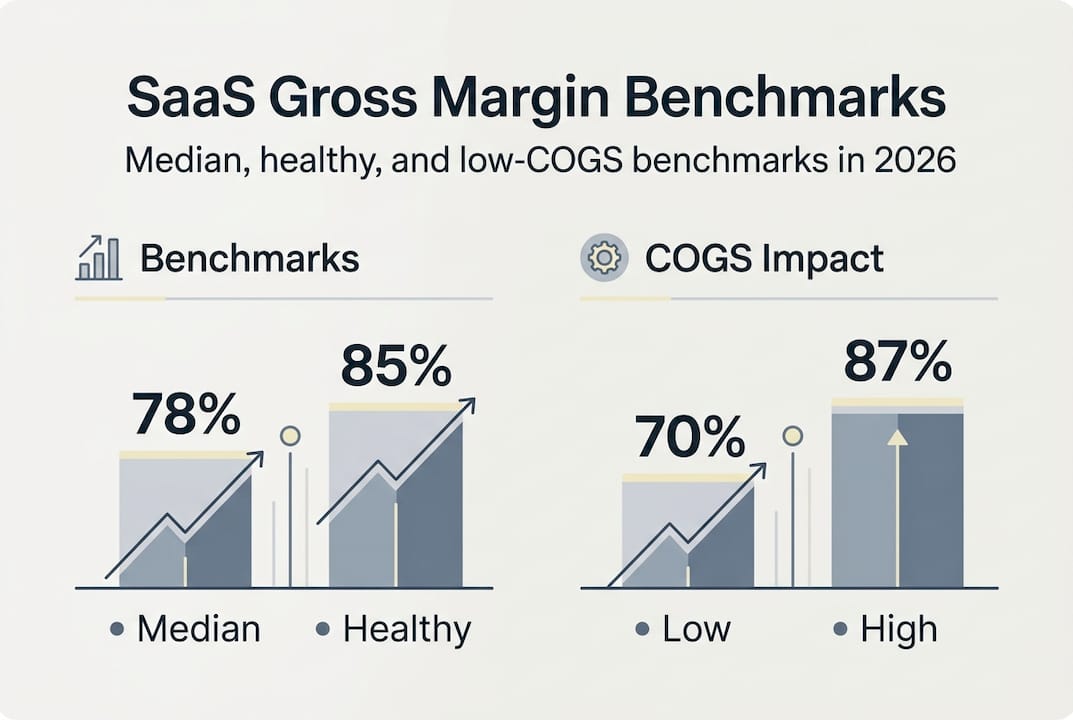
Here is how companies typically stack up:
| Performance tier | Subscription gross margin | Total gross margin |
|---|---|---|
| Top quartile (leaders) | 85%+ | 78%+ |
| Median (healthy) | 77 to 79% | 71 to 72% |
| Bottom quartile (laggards) | Below 70% | Below 65% |
| Red flag threshold | Below 65% | Below 60% |
A few important nuances to keep in mind:
- Subscription vs. total margin: If you offer professional services or implementation support alongside your SaaS product, your total gross margin will be lower. Services are inherently labor-intensive and carry thinner margins, often 20 to 40%. Blending these with subscription revenue pulls your aggregate margin down, sometimes significantly.
- Stage matters: Early-stage companies often have lower margins due to over-provisioned infrastructure. As you scale, unit economics should improve.
- Vertical differences: Infrastructure-heavy SaaS (IoT, video processing) naturally runs lower margins than pure software plays.
What triggers board and investor concern? Margins below 70% consistently raise questions about pricing power, cost structure, and long-term scalability. If your numbers are in that range, it is worth proactively addressing the issue before your next fundraise or board meeting.
If you want to optimize SaaS profitability, understanding where you sit relative to these benchmarks is the first step. It tells you whether you have a pricing problem, a cost problem, or both.
Stat to know: SaaS companies in the top quartile for gross margin generate significantly more free cash flow per dollar of revenue, giving them a structural advantage in both growth investment and downturns.
The SaaS gross margin formula in action: Calculating and analyzing your numbers
Understanding industry benchmarks is vital. Now here is how to calculate your own margin and find actionable insight.
Step-by-step calculation:
- Identify your subscription revenue. Use monthly or annual recurring revenue, excluding one-time fees and professional services if you want a clean subscription margin.
- List every COGS item. Hosting, support, embedded software, payment processing. Be thorough.
- Add up total COGS. This is your delivery cost for the period.
- Apply the formula. Subtract COGS from revenue, divide by revenue, multiply by 100.
Realistic example:
A SaaS company has $500,000 in monthly subscription revenue. Their COGS breaks down as follows: $60,000 in cloud hosting, $30,000 in customer support salaries, $10,000 in third-party software licenses, and $5,000 in payment processing. Total COGS equals $105,000.

Gross Margin = ($500,000 minus $105,000) divided by $500,000 = 79%. Solid. Right at the healthy median.
Common pitfalls to avoid:
- Underestimating support costs by only counting salaries and missing tools, training, and management overhead
- Ignoring cloud resource sprawl, where unused or over-provisioned instances quietly inflate your hosting bill
- Mixing professional services revenue with subscription revenue without separating the margins
Good SaaS budgeting and cost control practices start with accurate COGS categorization. If your numbers are blended or approximate, your gross margin is not telling you the full truth.
Moving beyond aggregate margin is where things get interesting. Cost allocation in SaaS by product line, customer segment, or cohort reveals opportunities that a single company-wide number hides. You might find that your enterprise customers are far more profitable than your SMB segment, or that one product line is dragging down an otherwise healthy margin.
Pro Tip: Benchmark against peers but prioritize internal trends and customer-level margins over aggregate numbers. Your own trajectory matters more than hitting an industry average.
“The most dangerous gross margin is the one you think you understand but haven’t broken down by customer or product yet.”
Optimizing and improving SaaS gross margin in 2026
Once you know your margin, the next step is systematic, data-driven improvement. The good news is that SaaS gross margin is one of the most controllable metrics in your business.
Strategies that move the needle in 2026:
- Cloud cost optimization: Right-size your infrastructure. Use reserved instances, spot pricing, and auto-scaling. Many SaaS companies overspend on cloud by 20 to 30% simply from poor resource management.
- AI-driven efficiency: AI and cloud optimization are no longer optional for maintaining competitive margins. AI can automate support triage, reduce ticket volume, and optimize infrastructure allocation in real time.
- Automate manual workflows: Every manual process in customer onboarding, billing, or support is a hidden cost. Automating these reduces headcount dependency and improves margin without sacrificing quality.
- Renegotiate vendor contracts: As you scale, your leverage with cloud providers and software vendors increases. Use it.
- Analyze margin by customer segment: Some customers cost far more to serve than others. Knowing this lets you reprice, restructure, or deprioritize low-margin accounts.
A critical warning: do not cut costs in ways that degrade reliability or support quality. Churn triggered by poor customer experience will cost you far more in lost ARR than you saved on support headcount.
For deeper strategies, explore SaaS cost optimization methods and SaaS growth hacks for 2026 to find approaches that fit your stage and model. Staying current on 2026 SaaS finance trends also helps you anticipate cost pressures before they hit your margin.
Pro Tip: Set a quarterly gross margin review as a standing agenda item with your leadership team. Margins drift slowly, and catching a 2 to 3 point decline early is far easier than reversing a 10-point drop.
Why true SaaS leaders go beyond the average gross margin
Here is something most articles won’t tell you: hitting the median benchmark is not a win. It is a baseline. The founders who build truly defensible SaaS businesses treat gross margin as a living signal, not a quarterly checkbox.
Average benchmarks tell you whether you are in the game. What they cannot tell you is where inside your business the real margin story is hiding. We have seen founders discover that their top 20% of customers generate 90% of their gross profit, while the bottom 40% are actually margin-negative when support costs are fully allocated. That insight changes everything: pricing, sales targeting, product investment.
Benchmark against peers but focus relentlessly on internal trends and customer-level margins. The aggregate number is a starting point, not a destination.
AI and cloud strategies are also shifting from nice-to-have to table stakes. Companies that fail to optimize infrastructure and automate support workflows in 2026 will find themselves structurally below the 70% threshold within two to three years as competition intensifies and cost pressures compound.
The founders who win are those who treat profitability strategies for SaaS as a continuous discipline, not a one-time project. Granular margin analysis, done consistently, is one of the highest-leverage activities a SaaS leader can invest in.
Get clarity on your SaaS metrics for growth
Knowing your gross margin is just the beginning. Acting on it, consistently and with the right data, is what separates companies that scale efficiently from those that grow into financial trouble.
At Meticq, we help SaaS founders track the right SaaS metrics in real time, from gross margin to NRR to burn rate, without the overhead of a full-time CFO. Our platform automates the financial workflows that slow you down and gives you the clarity to make faster, smarter decisions. Whether you are working on budgeting for SaaS in 2026 or tracking metrics for SaaS growth, Meticq gives you the financial infrastructure to scale with confidence.
Frequently asked questions
What costs are included in SaaS COGS for gross margin calculations?
SaaS COGS includes direct delivery costs like hosting, customer support, and embedded software licenses. Sales, marketing, R&D, and general administrative costs are excluded because they do not directly relate to delivering your product to customers.
What is a good gross margin for a SaaS business in 2026?
A healthy subscription gross margin targets 75 to 85% or higher, with a 2026 median of around 77 to 79%. Anything consistently below 70% signals a structural issue worth addressing urgently.
How can SaaS founders improve their gross margin?
Focus on cloud infrastructure optimization, workflow automation, and analyzing margin at the customer and product level. AI and cloud optimization are particularly critical levers for improving margin in 2026 without sacrificing product quality.
Why do some SaaS companies have lower gross margins?
Lower margins often result from heavy professional services components, inefficient cloud spending, or poor COGS allocation that signals operational issues. Companies mixing services revenue with subscription revenue without separating the margins are especially prone to this problem.