Cloud bills have a way of arriving like a surprise guest at the worst possible time. You approved a budget, your team shipped features, and somehow the numbers still don’t add up. For most SaaS founders, the real problem isn’t the spending itself — it’s the lack of clarity about where the money went and why. Cost allocation is the discipline that connects your spending to specific products, teams, and features, turning a confusing expense report into a strategic tool. This guide breaks down the core methods, shares real SaaS benchmarks, and gives you a practical framework to make cost allocation work for your business.
Table of Contents
- Why cost allocation matters for SaaS growth
- Core cost allocation methods used in SaaS
- How to allocate shared, cloud, and non-attributable costs
- Best practices: FinOps, automation, and benchmarks
- A hard-won lesson: clarity beats perfection every time
- Next steps: Build your allocation engine for scale
- Frequently asked questions
Key Takeaways
| Point | Details |
|---|---|
| Understand allocation impact | Precise cost allocation reveals your true unit economics and drives better SaaS decisions. |
| Choose the right method | Start simple with direct or usage-based methods, then evolve toward more granular tracking as you scale. |
| Handle shared costs smartly | Allocate shared and untagged expenses through fair drivers and aim to keep ‘neutral’ buckets under 5%. |
| Leverage automation and benchmarks | Systematize allocation with FinOps tools and compare against SaaS-specific metrics for ongoing improvement. |
Why cost allocation matters for SaaS growth
Now that we’ve set the stage, let’s explore why cost allocation deserves a central place in your SaaS playbook.
Cost allocation is the process of assigning expenses to the products, teams, or business units that generate them. Done well, it reveals your true cost of goods sold (COGS) and shows which parts of your business are profitable. Done poorly, it creates blind spots that quietly erode margins and mislead pricing decisions.
Here’s what’s at stake for SaaS companies specifically:
- Product margin visibility: Without allocation, you can’t know if your enterprise tier is subsidizing your free plan.
- Pricing accuracy: Underpriced plans often trace back to untracked infrastructure costs.
- Engineering accountability: Teams that see their cloud spend make smarter architectural decisions.
- Investor confidence: Clean, allocated financials signal operational maturity to VCs and acquirers.
The numbers tell a clear story. Cloud infra runs 8-15% of revenue for most SaaS companies, with waste averaging 27% of that spend. That’s a meaningful chunk of your budget disappearing into untracked or misattributed costs.
“The companies that treat cost allocation as a strategic function — not just a finance chore — are the ones that hit 70-85% gross margins and hold them.”
The top cost drivers in SaaS are cloud infrastructure, shared services (like authentication, logging, and monitoring), and security tooling. These categories are also the hardest to allocate because they serve multiple products or teams simultaneously. IT inefficiency compounds the problem: when costs aren’t visible, teams can’t course-correct.
Founders who invest in SaaS cost optimization and reach what FinOps practitioners call “run” maturity — meaning allocation is automated and reviewed regularly — reduce waste by up to 40%. That’s not a rounding error. That’s runway, headcount, or product investment.
The business case is simple: allocation isn’t overhead. It’s a growth lever.
Core cost allocation methods used in SaaS
With the stakes clear, it’s time to unpack the main cost allocation strategies SaaS companies use.

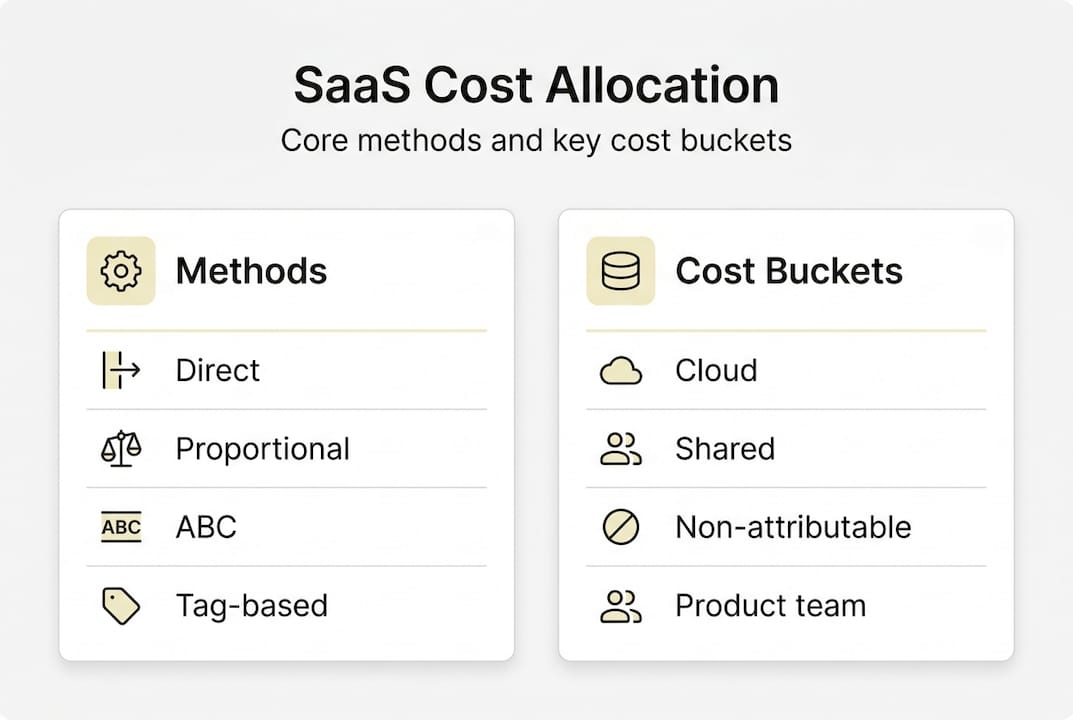
Key allocation methodologies include direct, proportional, tag-based, activity-based costing (ABC), cost pool, and even or weighted splits. Each has a different level of complexity, data requirement, and accuracy. Here’s a quick comparison:
| Method | Best for | Data needed | Accuracy | Effort |
|---|---|---|---|---|
| Direct | Large, traceable costs | Low | High | Low |
| Usage-based | Cloud infra | Medium | High | Medium |
| Tag-based | Multi-product infra | Medium | High | Medium |
| Activity-based (ABC) | Complex/multi-product | High | Very high | High |
| Cost pool | Shared services | Medium | Medium | Medium |
| Even/weighted split | Small teams, early stage | Low | Low | Low |
Simple methods are easier but less accurate; sophisticated methods require more data but provide better insights. The right choice depends on your stage and the granularity you need.
Here’s how to think about sequencing your approach:
- Start with direct allocation for costs you can clearly trace, like a dedicated database for one product.
- Add usage-based allocation for shared infrastructure, splitting costs by compute hours, storage consumed, or API calls.
- Implement tag-based allocation once your cloud environment is tagged by product, team, or environment.
- Graduate to ABC when you have multiple products with distinct cost profiles and need precise margin reporting.
Understanding your SaaS cost structure is the prerequisite for choosing the right method. If you don’t know what you’re spending on, you can’t allocate it accurately. Pair allocation with your core SaaS metrics to see how costs connect to growth.
Pro Tip: Don’t try to implement ABC from day one. Start with direct and usage-based methods for quick wins and meaningful visibility. You can refine the model as your data infrastructure matures.
How to allocate shared, cloud, and non-attributable costs
While core methods are foundational, allocating ambiguous or shared costs poses special challenges SaaS teams must solve.
Shared infrastructure is the hardest category to get right. A single database might serve three products. A monitoring stack might cover your entire platform. These costs are real, but they don’t belong to any one team by default.
Here are proven techniques for the most common problem areas:
- Shared databases and networks: Allocate by data volume (GB), query count, or connection hours. Pick the metric that best reflects actual usage.
- Reserved instances (RIs) and savings plans: Distribute discounts proportionally based on on-demand equivalent spend, so teams that drive usage also receive the savings benefit.
- Security and compliance costs: Allocate by headcount or revenue share, since these costs protect the whole business proportionally.
- Logging and monitoring: Split by event volume or resource count per product.
Cloud costs managed via tagging, business maps, shared service drivers, and handling discounts create a traceable, auditable allocation system. Without these practices, shared costs pile up in a catch-all bucket that obscures true margins.
“Every dollar sitting in an untagged bucket is a dollar your product team can’t optimize.”
Here’s a sample allocation framework for common cost buckets:
| Cost bucket | Driver | Allocation metric | Typical share of budget |
|---|---|---|---|
| Compute | Product usage | CPU/memory hours | 35-45% |
| Database | Data volume | GB stored or queries | 15-25% |
| Security/compliance | Business scale | Headcount or revenue % | 8-12% |
| Shared services | Platform usage | API calls or events | 10-15% |
| Unallocated | N/A | Neutral bucket | <5% |
Non-attributable and untagged resources should be capped at under 5% in a neutral bucket. If your unallocated share is higher, it’s a signal to invest in tagging discipline before refining your allocation model. Review your expense management guide and SaaS bookkeeping tips to build the operational foundation that makes this possible. Explore cloud allocation strategies for additional tooling and tagging frameworks.
Best practices: FinOps, automation, and benchmarks
Ultimately, it’s not the method on paper but the ongoing discipline and tooling that enables results. Here’s how leading SaaS teams operationalize cost allocation.
FinOps is a cultural and operational framework that brings finance, engineering, and product together around cloud cost accountability. In practice, it means three things: automated allocation pipelines, cross-team visibility, and a regular review cadence.
Here’s how to build that discipline step by step:
- Automate tagging enforcement at the infrastructure level so new resources are automatically labeled by product, team, and environment.
- Set up automated cost reports that go to product managers and engineering leads weekly, not just the finance team.
- Establish a monthly allocation review at the exec level to catch anomalies and re-prioritize spend.
- Use peer benchmarks to calibrate your targets. SaaS gross margins of 70-85% are the standard; if you’re below that, allocation data will show you where to focus.
- Tie allocation insights to pricing decisions. If a feature costs more to serve than it generates, that’s a pricing or architecture conversation.
Implement a FinOps culture with automated pipelines, cross-team review, and peer benchmarks to move from reactive cost management to proactive optimization. Mature teams reduce cloud waste by up to 40% — that’s the measurable payoff for building this discipline.
“The goal isn’t perfect allocation. The goal is enough visibility to make better decisions faster.”
For security-heavy SaaS companies, check out this cybersecurity guide for context on how security costs should be scoped and allocated. Pair these practices with scaling SaaS finance and SaaS profitability strategies to build a finance function that scales with your growth.
Pro Tip: Review your allocation model monthly at both the product and exec level. Use the insights to re-price underperforming plans, re-architect expensive features, and redirect savings into growth initiatives.
A hard-won lesson: clarity beats perfection every time
Before you overhaul your entire cost allocation system, here’s the uncomfortable truth most SaaS leaders eventually learn.
Most founders get stuck chasing a theoretically perfect allocation model. They spend weeks debating whether to use CPU hours or memory hours for a shared compute cluster. Meanwhile, 30% of their cloud budget sits untagged and unreviewed.
The real unlock isn’t precision. It’s transparency. When teams can see their costs, behavior changes. Engineers start questioning whether that always-on dev environment is necessary. Product managers think twice before adding a third-party integration with unpredictable usage costs.
Start with “showback” before “chargeback.” Showback means sharing cost data with teams for awareness, without billing them internally. This builds the culture of ownership without the politics of internal billing. Once teams trust the data, chargeback becomes much easier to implement.
The companies that win at cost allocation aren’t the ones with the most sophisticated models. They’re the ones that make costs visible, give teams ownership, and iterate consistently. Use budgeting with metrics to connect allocation insights to your broader financial planning rhythm.
Keep the model simple enough that a product manager can explain it. That’s your real benchmark.
Next steps: Build your allocation engine for scale
Ready to move from theory to action? These resources can help accelerate your progress.
The frameworks in this guide give you a clear starting point, but implementation is where most teams stall. You need the right metrics, the right tooling, and a financial partner who understands SaaS-specific cost structures.

Meticq is built for exactly this. We help SaaS founders automate financial workflows, track the KPIs that matter, and build allocation models that scale with your business. Whether you’re setting a baseline or optimizing an existing system, start with SaaS budgeting basics to anchor your cost allocation in real metrics. Then use our guides on core SaaS metrics and key SaaS metrics to connect allocation data to the numbers that drive your growth decisions.
Frequently asked questions
What is the best cost allocation method for small SaaS companies?
Direct or usage-based methods are best for small SaaS companies because they’re easy to implement and generate actionable insights without requiring complex data infrastructure.
How much of cloud costs should remain unallocated?
Best practices cap unallocated costs at under 5% by using consistent tagging and resource mapping techniques across your cloud environment.
What are the most common cost allocation mistakes in SaaS?
The most common mistakes are ignoring shared service costs and overcomplicating allocation models, which reduces team adoption and leaves the biggest cost buckets unmanaged.
How do SaaS leaders use allocation to improve margins?
They allocate costs by product or team, identify inefficiencies, and use gross margin benchmarks of 70-85% to target specific cost categories for reduction or renegotiation.
How often should allocation models be reviewed?
Review your model quarterly or after major product or infrastructure changes. Cross-team FinOps reviews keep allocation accurate and ensure teams stay accountable to the data.