SaaS expenses scale faster than headcount, and most founders don’t notice until the damage is done. Auto-renewals, per-user pricing, and shadow IT quietly inflate your software bill while your team stays focused on growth. The result is a bloated, unpredictable cost structure that erodes margins and complicates fundraising conversations. This guide breaks down exactly what SaaS expense management is, how it works in practice, which metrics matter most, and what frameworks you can apply today to stop the bleed and build a leaner, more scalable operation.
Table of Contents
- What is SaaS expense management?
- Core mechanics: How SaaS expense management works
- Key metrics and KPIs for SaaS expense management
- Nuances and challenges founders overlook
- Best practices: Strategic frameworks for effective SaaS expense management
- Smarter SaaS growth begins with disciplined expense management
- Frequently asked questions
Key Takeaways
| Point | Details |
|---|---|
| Define and track SaaS spend | Treat SaaS expenses as dynamic recurring costs needing dedicated management, not just a line item. |
| Automate monitoring and optimization | Use modern SaaS management tools to surface waste and assign accountability, multiplying savings as you grow. |
| Watch for shadow IT and renewal traps | Unmanaged subscriptions and auto-renewals often hide 20–30% waste, so regular audits are vital. |
| Metrics drive better decisions | Benchmarks like spend per employee and license utilization reveal quick wins and deeper issues. |
| Balance control with agility | Smart governance ensures efficiency without stifling the innovation modern SaaS startups need. |
What is SaaS expense management?
Now that you’ve seen how SaaS spend can surprise even savvy founders, let’s clarify exactly what it means and why it’s unlike traditional cost control.
SaaS expense management is a structured process of identifying, tracking, forecasting, and optimizing software spend across your entire organization. It’s not just about cutting costs. It’s about knowing what you’re paying for, whether it’s being used, and whether it’s aligned with your growth goals.
This is fundamentally different from general expense management. Travel and entertainment (T&E) costs are episodic. You book a flight, pay for it, and it’s done. SaaS costs are recurring. They compound month over month, often with automatic price increases tied to seat counts or usage tiers. Understanding your SaaS cost structure is the first step toward controlling it.
Here’s what SaaS expense management actually covers:
- Software subscriptions across all departments (engineering, sales, marketing, HR, finance)
- License counts and whether they match actual headcount
- Renewal dates and contract terms that lock you into multi-year commitments
- Usage data to identify tools that are paid for but rarely opened
- Shadow IT purchases made outside of formal procurement
“Neglecting SaaS expense management isn’t just a finance problem. It’s a growth problem. Every dollar wasted on unused tools is a dollar not invested in customer acquisition or product development.”
For high-growth SaaS companies, this discipline is especially critical. Your software stack grows with every new hire and every new initiative. Without a system, you’re flying blind.
Core mechanics: How SaaS expense management works
With a clear definition in hand, let’s dig into the mechanics that transform SaaS expense management from an abstract concept into tangible savings.
The core mechanics include inventory creation, usage measurement, classification, forecasting, and optimization. Here’s how each step works in practice:
- Inventory intake: Catalog every tool your company pays for, including those purchased on personal cards or departmental budgets.
- Usage tracking: Connect to your tools via APIs or SSO logs to measure actual login frequency and feature adoption.
- Classification: Tag each tool by department, function, and business criticality so you can prioritize cuts intelligently.
- Forecasting: Model future spend based on headcount growth, planned tool additions, and upcoming renewals.
- Optimization: Cancel underused licenses, renegotiate contracts, consolidate overlapping tools, and right-size seat counts.
Most high-performing SaaS teams automate steps two through five using SaaS Management Platforms (SMPs). The ROI is significant. Automation surfaces waste faster, reduces manual audit time, and ensures renewals don’t sneak up on you. This is a core part of optimizing SaaS profitability at scale.
Manual tracking vs. automated SMP tools
| Capability | Manual (spreadsheets) | Automated SMP |
|---|---|---|
| Tool discovery | Incomplete, relies on self-reporting | Full visibility via SSO/API |
| Usage tracking | Not feasible at scale | Real-time data |
| Renewal alerts | Calendar reminders (often missed) | Automated notifications |
| License optimization | Quarterly at best | Continuous |
| Audit time | 10+ hours per cycle | Under 1 hour |
| Accuracy | Low (human error) | High |
Spreadsheets work when you have five tools. They break down at fifty. If you’re serious about SaaS cost optimization, the shift to automated tooling is non-negotiable. Understanding SaaS accounting principles also helps you categorize these costs correctly on your P&L.

Pro Tip: Assign a named owner to every tool in your stack. When someone is accountable for a subscription, underused licenses get flagged faster and renewal decisions become intentional rather than automatic.
Key metrics and KPIs for SaaS expense management
Mechanics are only as powerful as the metrics they illuminate. Here are the numbers that actually matter.
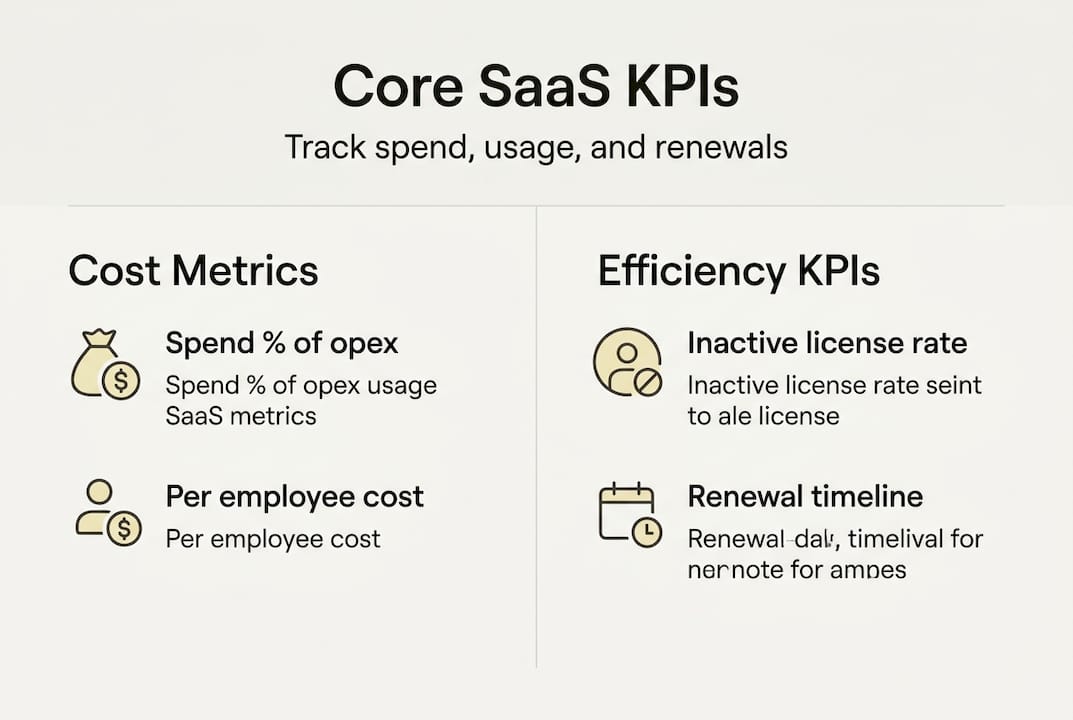
Key KPIs include SaaS spend as a percentage of opex and revenue, cost per employee, inactive license ratio, and renewal stacking avoidance. Track these consistently and you’ll spot problems before they become expensive.
SaaS spend benchmarks by stage
| Metric | Early-stage | Growth-stage (>$1M ARR) |
|---|---|---|
| SaaS spend per employee | ~$12,000/year | ~$27,000/year |
| SaaS as % of revenue | 6–15% | 8–20% |
| Inactive license ratio | Target <10% | Target <5% |
| Renewal stacking risk | High (untracked) | Managed (automated) |
These benchmarks come from SaaS budgeting metrics research and give you a realistic baseline for your stage. If your spend per employee is significantly above these numbers, that’s a signal worth investigating.
Statistic to know: Studies consistently show that 20 to 30% of SaaS spend is pure waste, driven by unused licenses, duplicate tools, and forgotten subscriptions. For a company spending $500,000 annually on software, that’s up to $150,000 recoverable with the right system.
Common mistakes founders make with these metrics:
- Ignoring inactive licenses: Paying for seats that haven’t been logged into in 90 days is a direct cash drain.
- Failing to forecast with headcount: Every new hire triggers new license needs. Without a model, you’re always reacting.
- Treating SaaS spend as fixed: It’s variable. Negotiate it like one.
- Missing renewal stacking: Multiple large contracts renewing in the same quarter creates cash flow pressure.
Knowing what SaaS metrics to measure and when to act on them is what separates reactive founders from proactive operators. Your founder budgeting guide should include a dedicated SaaS spend section updated at least quarterly.
Nuances and challenges founders overlook
Just tracking what you buy isn’t enough, especially as your company scales. Here’s what even sharp teams tend to miss.
The biggest hidden risk is shadow IT. This refers to software purchased by individual employees or teams without going through a formal procurement process. It’s common, and it’s costly. Shadow IT and auto-renewals often account for 20 to 30% of spending waste, and most finance teams have no visibility into it until a credit card statement surfaces the problem.
“Shadow IT isn’t just a security risk. It’s a financial one. When employees buy tools independently, you lose negotiating leverage, duplicate existing capabilities, and create compliance gaps that are expensive to unwind.”
Other traps that catch founders off guard:
- Auto-renewal clauses that lock you into another year before you’ve evaluated the tool
- Overlapping purchases where two departments buy tools with identical functionality
- Unassigned tool owners so no one is accountable when renewal time arrives
- Accrual vs. actuals mismatch where your books show one number but your bank account tells a different story
SaaS expense management also differs from general expense management in important ways. General expense management handles episodic, one-time costs like travel, meals, or office supplies. SaaS costs are recurring, often annual, and tied to usage patterns that change as your team grows. Your SaaS founder budgeting process needs to treat these as a separate category with its own governance. Good SaaS bookkeeping tips will help you keep these categories clean and auditable.
Best practices: Strategic frameworks for effective SaaS expense management
With the biggest pitfalls out in the open, here’s how today’s top SaaS operators build durable, scalable expense management systems without sacrificing innovation.
Expert best practices center on centralized intake, vendor-specific budgets, usage-based forecasting, and governance. The goal is a system that runs with minimal manual effort and surfaces decisions automatically.
Here’s how to operationalize it:
- Centralize approvals: All new software purchases go through a single intake process, regardless of department or deal size.
- Run periodic audits: Schedule quarterly reviews of your full tool inventory. Compare usage data against license counts.
- Apply zero-based budgeting (ZBB): Each renewal cycle, justify the tool from scratch rather than auto-approving the renewal.
- Build usage-based forecasts: Model your SaaS spend against headcount projections so you’re never surprised by growth-driven cost spikes.
- Assign dedicated budgets per vendor category: Engineering tools, sales tools, and marketing tools each get their own budget envelope.
Pro Tip: Deploy a SaaS Management Platform to automate inventory discovery and renewal tracking. The SaaS spend strategy that works at scale is one where your finance team gets alerts, not surprises.
One tension worth naming: finance-led cost-cutting vs. alignment with product strategy is a real organizational challenge. Engineering and product teams need flexibility to experiment with new tools. Finance needs predictability and control. The solution is a lightweight governance model: fast approvals for low-cost tools, deeper review for annual contracts above a set threshold.
Good bookkeeping tips and solid SaaS financial planning practices make this governance model easier to sustain. And automation in SaaS finance is what makes it scalable without adding headcount to your finance team.
Smarter SaaS growth begins with disciplined expense management
Applying these frameworks can deliver immediate ROI. But knowing the frameworks is only half the battle. Execution requires the right systems, the right metrics, and ideally a financial partner who understands the SaaS model from the inside.
At Meticq, we work with SaaS founders to automate financial workflows, track the KPIs that matter, and build the kind of financial clarity that supports confident decision-making. Whether you’re cleaning up your bookkeeping for SaaS, getting a handle on your budgeting basics for SaaS, or exploring automation for SaaS finance, we’ve built the tools and the expertise to help you move faster with fewer surprises. Disciplined expense management isn’t a constraint on growth. It’s what makes growth sustainable.
Frequently asked questions
How is SaaS expense management different from general expense management?
SaaS expense management focuses on recurring software costs and usage patterns, while general expense management covers episodic spend like travel or office supplies. The recurring nature of SaaS costs requires a separate governance model and forecasting approach.
What is typical SaaS spend per employee for early-stage companies?
Median SaaS spend is approximately $12,000 per employee at early-stage, which typically represents 6 to 15% of total revenue. Growth-stage companies often see this rise to $27,000 per employee as the tool stack expands.
What are the top three ways to cut SaaS waste quickly?
Inventorize every tool you’re paying for, track actual usage data against license counts, and cancel or downgrade subscriptions with low adoption. This approach can recover 20 to 30% of your current SaaS spend.
How do shadow IT and auto-renewals impact SaaS expense management?
Shadow IT and auto-renewals together account for 20 to 30% of wasted SaaS spend in most growing companies. Without centralized visibility, these costs accumulate silently until they create a real budget problem.