TL;DR:
- Clarity in SaaS means understanding the core problem, customer profile, and priorities.
- Lack of clarity leads to increased costs, churn, and stalled growth.
- Building and maintaining clarity involves defining metrics, streamlining decisions, and regular reviews.
Most SaaS founders assume their biggest threat is a competitor shipping faster or a product missing a key feature. The real threat is quieter. It lives inside unclear priorities, misaligned teams, and metrics that no longer reflect what the business actually needs. Clarity is not a soft concept. It is a strategic asset that determines how fast you can move, how well your team executes, and whether your numbers trend in the right direction. This article breaks down what clarity actually means for SaaS founders, how its absence shows up in your financials, and what you can do to build it systematically.
Table of Contents
- The true meaning of clarity for SaaS founders
- How a clarity deficit sabotages SaaS growth metrics
- Clarity and founder mindset: avoiding operational bottlenecks
- How to build and sustain clarity across your SaaS company
- The uncomfortable truth most SaaS founders ignore about clarity
- Clarity equals actionable metrics: Next steps for SaaS founders
- Frequently asked questions
Key Takeaways
| Point | Details |
|---|---|
| Clarity fuels growth | A clear vision and priorities help SaaS founders accelerate smarter growth and avoid costly missteps. |
| Metrics reflect focus | Your churn, CAC, and NRR quickly reveal whether your company operates with real clarity. |
| Mindset shapes scaling | Clear delegation and founder mindset are crucial for scaling teams and innovations effectively. |
| Simple steps win | Simple frameworks and regular clarity checks outperform complexity-heavy management. |
The true meaning of clarity for SaaS founders
Clarity in a SaaS context is not about having all the answers. It is about knowing which questions matter most right now. Specifically, it means having a sharp understanding of three things: your core problem (what pain you solve), your ideal customer profile (who you solve it for), and your current priorities (what your team focuses on this quarter).
Many founders confuse clarity with control. Control is about managing every decision. Clarity is about making fewer decisions necessary in the first place. When your team understands the direction, they act without waiting for approval. That is agility, not rigidity.
Clarity on core problem, vision, and priorities prevents decision paralysis and maintains team alignment in fast-paced SaaS environments. Without it, every meeting becomes a negotiation about what matters, and every sprint becomes a guessing game.
Here is how clarity impacts the key areas of your business:
- Vision: Teams know what they are building toward and why.
- ICP alignment: Sales, marketing, and product stop pulling in different directions.
- Product focus: Features get built for the right customers, not just the loudest ones.
- Financial decisions: Resources go where they generate the most return.
High clarity vs. low clarity startups
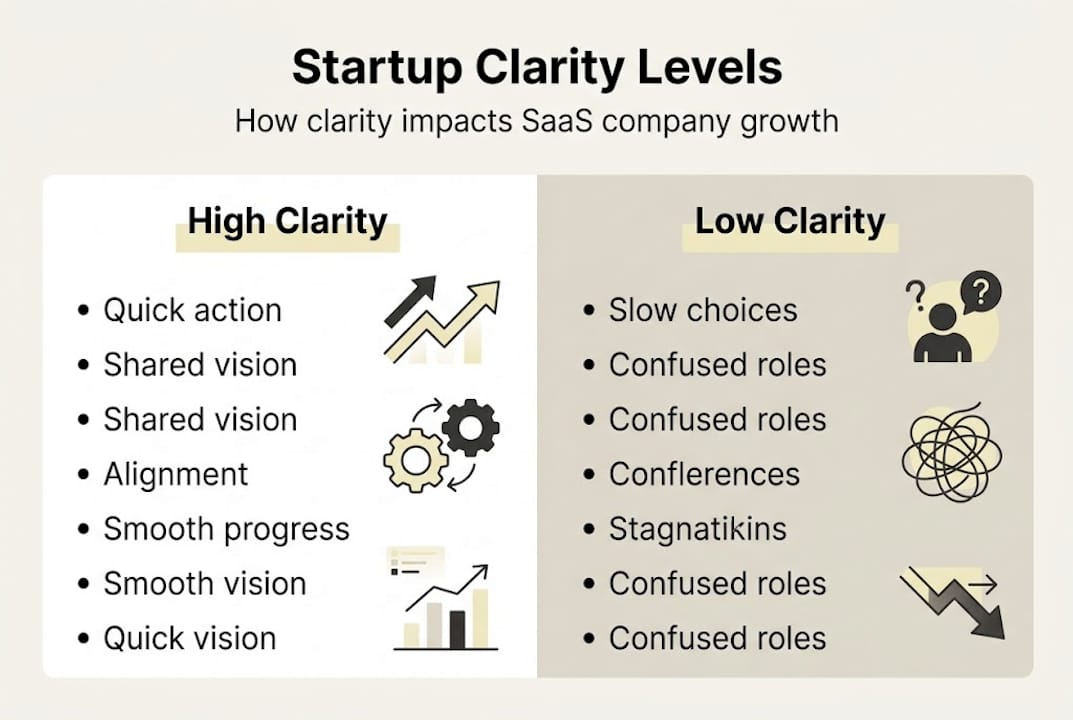
| Dimension | High clarity startup | Low clarity startup |
|---|---|---|
| Decision speed | Fast, decentralized | Slow, founder-dependent |
| Team alignment | Consistent priorities | Competing agendas |
| Product roadmap | ICP-driven, focused | Feature-heavy, scattered |
| Metrics tracking | North star focused | Vanity metrics dominant |
| Growth trajectory | Predictable | Erratic |
If you look at competitive SaaS benchmarks, the companies outperforming their peers almost always have tighter focus, not broader feature sets.
Pro Tip: Pick one north star metric that reflects real customer value, such as weekly active users or net revenue retention. Review it weekly with your leadership team. It becomes a shared compass that reduces noise and keeps everyone oriented.
How a clarity deficit sabotages SaaS growth metrics
Once you understand what clarity looks like, it becomes easy to spot its absence in your numbers. A clarity deficit does not announce itself. It shows up gradually in rising costs, slipping retention, and growth that stalls without an obvious reason.
Here is how the snowball typically rolls:
- Unclear priorities lead to building features for every customer request instead of your core ICP.
- Overbuilt product confuses new users, slowing activation and stretching time to value.
- High churn and rising CAC follow as the product fails to deliver a clear, repeatable outcome.
- Flat or declining growth sets in as sales cycles lengthen and word-of-mouth weakens.
This pattern is not rare. A strategy deficit in SaaS causes feature factory syndrome, rising CAC of 20 to 30 percent per quarter, elevated churn, and failure before Series B for roughly 70 percent of SaaS companies.
The industry context makes this even more urgent. 2025 B2B SaaS benchmarks show median annual revenue growth at 28 percent, down from 47 percent, with annual churn at a median of 12.5 percent and sales and marketing multiples at roughly 3x, half of prior year levels. The margin for error has shrunk significantly.
Clear vs. unclear SaaS startup metrics
| Metric | Clear-focus startup | Unclear-focus startup |
|---|---|---|
| CAC trend | Stable or declining | Rising 20 to 30% per quarter |
| Annual churn | Below 10% | Above 15% |
| NRR | Above 110% | Below 100% |
| Revenue growth | Above 30% annually | Flat or declining |
| Payback period | Under 12 months | 18 months or more |
Tracking key SaaS metrics consistently is how you catch these warning signs early. If your CAC is climbing without a clear explanation, or if you are managing SaaS churn reactively rather than proactively, a clarity deficit is likely the root cause.
Clarity and founder mindset: avoiding operational bottlenecks
The metric damage from unclear priorities is real. But the human cost is just as significant. When founders lack clarity on what they should be doing versus what their team should be doing, the entire organization slows down.
Common operational symptoms include:
- Founders approving decisions that should be made two levels down.
- Engineers waiting for product direction before starting sprints.
- Sales teams pitching different value propositions to similar prospects.
- Customer success teams solving problems that product should have prevented.
- Leadership meetings that revisit the same unresolved questions repeatedly.
“Lack of founder clarity on mindset and delegation creates scaling bottlenecks: burnout, stifled innovation, demotivated teams, and unscalable processes.”
This is not a people problem. It is a clarity problem. When the founder has not clearly defined what decisions they own versus what the team owns, everyone defaults to asking the founder. That creates a single point of failure at the top.

Founders who are scaling SaaS growth successfully tend to share one trait: they have made their thinking visible. Their team knows the priorities, the constraints, and the decision-making criteria without needing to ask.
If you are heading into a fundraise, this matters even more. Investors look for founders who have clarity on their numbers, their market, and their team structure. A fundraising mindset built on clear delegation and documented priorities signals maturity and reduces investor risk perception.
Pro Tip: Run a monthly clarity check. Ask yourself and your leadership team: What are our top three priorities this month? Who owns each one? What does success look like? If you get different answers from different people, you have a clarity gap to close.
How to build and sustain clarity across your SaaS company
Clarity is not a one-time exercise. It requires active maintenance, especially as your team grows and your product evolves. Here is a practical approach to building it into your operating rhythm.
Steps to create and sustain clarity:
- Define your ICP in writing. Not a persona slide. A real document that describes the exact customer who gets the most value from your product, why they buy, and what success looks like for them.
- Set a single north star metric. One number that reflects customer value and business health. Align every team around it.
- Document decision rights. Write down who can make which decisions without escalation. Share it with the full team.
- Run quarterly priority reviews. Revisit your top three company priorities every quarter. Kill anything that does not serve them.
- Track leading indicators, not just outcomes. Metrics like activation rate, time to value, and feature adoption tell you where clarity is breaking down before churn or CAC show it.
SaaS founders often mistake control for clarity, leading to product breadth over focus, slower activation, stretched time to value, and lower retention including weakened NRR. The fix is not less involvement. It is more intentional involvement in the right places.
Best practices to reinforce clarity on an ongoing basis:
- Share your north star metric in every all-hands meeting.
- Require every new feature request to map to a specific ICP problem.
- Review your cost allocation strategies quarterly to ensure spend aligns with stated priorities.
- Use financial dashboards that surface SaaS-specific KPIs in real time, not just month-end reports.
- Celebrate decisions your team made independently. It reinforces that clarity, not approval, drives execution.
The goal is a company where your team can make good decisions without you in the room. That is what operational clarity actually looks like.
The uncomfortable truth most SaaS founders ignore about clarity
Here is what most advice on clarity gets wrong: it treats clarity as a destination rather than a practice. Founders read a framework, implement it once, and move on. Six months later, the noise is back.
The founders who scale well are not the ones with the most sophisticated systems. They are the ones who are ruthlessly willing to cut. Cut features that do not serve the ICP. Cut metrics that do not connect to real outcomes. Cut initiatives that sound exciting but dilute focus.
We have seen founders spend months debating OKR frameworks while their CAC climbs and NRR softens. The problem was never the framework. It was the unwillingness to make hard calls about what the company would not do.
Simplicity in priorities outperforms complexity every time. One clear goal, communicated consistently, beats five strategic pillars that nobody can recite. If your team cannot tell you the company’s top priority without looking at a slide deck, you do not have clarity. You have documentation.
Revisit the essentials regularly. Check out smarter growth hacks that reinforce focus over noise. The competitive edge in SaaS is not more. It is better.
Clarity equals actionable metrics: Next steps for SaaS founders
Clarity without measurement is just intention. Meticq helps SaaS founders turn strategic clarity into real, trackable outcomes by automating financial workflows and surfacing the metrics that actually matter.

If you are unsure which numbers to prioritize at your current stage, start with measuring SaaS metrics to build a focused dashboard. From there, explore metrics for SaaS growth to understand what top-performing companies track and why. And if you want CFO-level guidance without the full-time cost, our SaaS CFO tips show you exactly how to structure financial clarity at every stage of growth.
Frequently asked questions
What is the biggest risk of lacking clarity as a SaaS founder?
The biggest risk is making unfocused decisions that increase churn, balloon costs, slow growth, and ultimately jeopardize the company’s survival. A strategy deficit drives CAC up 20 to 30 percent per quarter and contributes to failure before Series B for 70 percent of SaaS companies.
How does founder clarity impact team performance?
Founder clarity drives team alignment and motivation, while a lack of clarity leads to bottlenecks, burnout, and demotivation. Scaling bottlenecks from unclear delegation stifle innovation and make processes unscalable as the company grows.
What are quick ways for SaaS founders to create clarity?
Set a clear north star metric, simplify priorities, and communicate them regularly across the company. Preventing decision paralysis starts with aligning your team on the core problem, vision, and top priorities.
How can SaaS founders check if they’re confusing control for clarity?
If you are micro-managing features or blocking fast decisions, you may be mistaking control for true clarity. Mistaking control for clarity leads to product breadth over focus, slower activation, and weakened NRR over time.