TL;DR:
- Benchmarking SaaS metrics provides essential external context for accurate performance assessment.
- Key KPIs like NRR, CAC, and churn vary by stage and funding model, guiding strategic decisions.
- Proper segmentation and reliable data are crucial to effective benchmarking and avoiding misleading conclusions.
Your SaaS metrics look solid until you compare them to the right benchmark. Churn at 5% monthly might feel manageable internally, yet against industry standards it signals serious trouble. Benchmarking SaaS metrics provides the context your internal numbers simply cannot offer on their own. Without that external reference point, you risk optimizing the wrong things, celebrating mediocre performance, or missing a competitive gap before it becomes a real threat. This guide breaks down which metrics to benchmark, how benchmarks shift by funding model, and the practical steps to do it right so you can make smarter, faster decisions.
Table of Contents
- Why benchmarking SaaS metrics matters: Beyond internal numbers
- Key metrics to benchmark for SaaS growth and health
- Benchmark variations: Bootstrapped, VC-backed, and hybrid SaaS
- How to benchmark: Practical steps and common pitfalls
- Our take: The hidden value and risks in SaaS benchmarking
- Take your benchmarking further: Tools and expert support
- Frequently asked questions
Key Takeaways
| Point | Details |
|---|---|
| Context is powerful | Benchmarking reveals whether your metrics are truly competitive or just internally positive. |
| Prioritize relevant metrics | Focus on NRR, CAC, churn, and gross margin—benchmarks for sustainable SaaS growth. |
| Segment for accuracy | Always compare using segmentation: ARR stage, funding type, GTM model, and pricing. |
| Avoid benchmarking mistakes | Don’t copy competitors blindly; use accurate data and contextual insights for best results. |
| Benchmarks guide, not dictate | Use benchmarks to inform strategy, but adapt them to your business’s unique stage and goals. |
Why benchmarking SaaS metrics matters: Beyond internal numbers
Benchmarking means comparing your company’s performance metrics against a relevant external reference group, whether that’s industry peers, companies at a similar ARR (Annual Recurring Revenue) stage, or businesses using the same go-to-market model. It is not just a reporting exercise. It is a strategic tool that tells you where you actually stand.
Tracking KPIs (Key Performance Indicators) in isolation creates a dangerous blind spot. You might see your CAC (Customer Acquisition Cost) holding steady quarter over quarter and assume things are fine. But if the industry median CAC for your segment dropped 15% while yours stayed flat, you are falling behind without realizing it. Benchmarking reveals whether metrics like churn or CAC are truly competitive or just consistent.
The same logic applies to churn. A 2% monthly churn rate sounds low until you learn that best-in-class SaaS companies in your category are achieving 0.5%. That gap compounds dramatically over 12 months and directly affects your LTV (Lifetime Value) calculations and revenue forecasts.
Here is what benchmarking actually reveals when done correctly:
- Competitive gaps you would never spot by watching internal trends alone
- Strategic strengths worth doubling down on because they outperform peers
- Misallocated spend in areas where you are over-investing relative to returns
- Growth ceiling risks when metrics plateau at below-market levels
- Investor readiness signals that show whether your numbers meet funding-stage expectations
“Benchmarking is not about copying competitors. It is about understanding the performance landscape so you can make deliberate, informed choices about where to push harder and where to hold back.”
This is why reporting drives SaaS success when it is built around external context, not just internal tracking. And it is why budgeting basics and metrics become far more powerful when tied to real-world benchmarks rather than last quarter’s numbers.
Key metrics to benchmark for SaaS growth and health
Not every metric deserves equal attention. Certain KPIs consistently predict whether a SaaS company will scale sustainably or stall. Here are the ones you should prioritize:
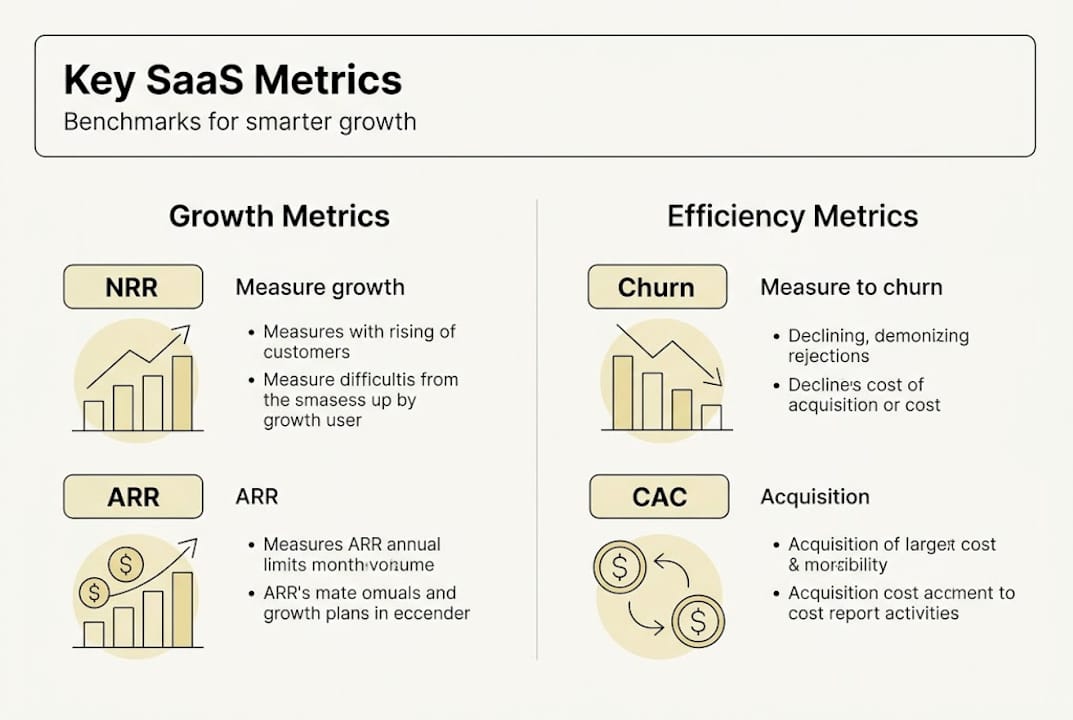
- NRR (Net Revenue Retention): Measures revenue growth from existing customers after accounting for churn, downgrades, and expansions. Above 100% means your existing base is growing without new sales.
- CAC (Customer Acquisition Cost): Total sales and marketing spend divided by new customers acquired in a period.
- LTV (Lifetime Value): The total revenue a customer generates over their entire relationship with you.
- Churn rate: The percentage of customers or revenue lost in a given period.
- Rule of 40: Growth rate plus profit margin should equal or exceed 40% for a healthy SaaS business.
| Metric | Early stage benchmark | Scale-up benchmark | Mature benchmark |
|---|---|---|---|
| NRR | 90%+ | 105%+ | 110%+ |
| CAC payback | Under 18 months | Under 12 months | Under 9 months |
| Gross margin | 60%+ | 70%+ | 75%+ |
| Monthly churn | Under 3% | Under 1.5% | Under 0.5% |
| Rule of 40 | 20%+ | 35%+ | 40%+ |
NRR above 110% is a key indicator of sustainable growth, and CAC payback combined with NRR are the strongest predictors of long-term performance according to the Efficient Growth matrix. The matrix essentially scores companies on capital efficiency, rewarding those who grow fast without burning disproportionately.
Benchmarking looks different depending on your stage:
- Early stage (under $1M ARR): Focus on churn and gross margin. These set the foundation.
- Scale-up ($1M to $10M ARR): Prioritize CAC payback and NRR. Efficiency starts to matter as much as growth.
- Mature ($10M+ ARR): Rule of 40 and LTV to CAC ratio become the primary health signals.
Pro Tip: Automate your metric tracking from day one. Manual spreadsheets introduce errors and lag. Use platforms built for SaaS finance to pull real-time data so your benchmarking comparisons are always current. Explore metrics to track for growth and financial health indicators to build a tracking system that scales with you. A SaaS CFO perspective can also help you prioritize which benchmarks matter most at your current stage.
Benchmark variations: Bootstrapped, VC-backed, and hybrid SaaS
Understanding key metrics is only part of the picture, because benchmarks vary based on how SaaS businesses are funded. Applying VC-backed growth benchmarks to a bootstrapped company is like grading a marathon runner on sprint times. The goals are fundamentally different.

Bootstrapped SaaS companies typically target a median growth rate around 20% with near-breakeven profitability. The priority is capital efficiency and sustainable margins, not top-line velocity at any cost. VC-backed companies, by contrast, are expected to grow faster, often 50% to 100%+ annually in early stages, but they accept higher burn rates in exchange for market share.
Hybrid paths are becoming more common. Many founders raise a small seed round to accelerate product development, then operate with bootstrapped discipline afterward. Post-2022, benchmarks have stabilized as the market corrected away from growth-at-all-costs thinking, making hybrid strategies increasingly attractive.
| Company type | Typical growth rate | Profitability focus | Burn rate tolerance |
|---|---|---|---|
| Bootstrapped | 15% to 25% | High (near breakeven) | Very low |
| VC-backed (early) | 80% to 150%+ | Low (growth first) | High |
| VC-backed (growth) | 40% to 80% | Moderate | Moderate |
| Hybrid | 25% to 50% | Moderate to high | Low to moderate |
What segmenting by funding model means for your performance goals:
- Bootstrapped: Benchmark against profitability and capital efficiency metrics, not raw growth rates
- VC-backed: Benchmark against growth velocity, NRR, and CAC payback relative to your funding stage
- Hybrid: Use a blended lens, efficiency metrics from bootstrapped frameworks plus growth targets from VC models
Misapplying benchmarks here is a real risk. If you are bootstrapped and chasing VC-level growth benchmarks, you may overspend on acquisition and destroy the margin that keeps you solvent. Explore growth hacks and scaling strategies that match your actual funding model.
How to benchmark: Practical steps and common pitfalls
With benchmark differences clarified, it is essential to execute benchmarking thoughtfully to maximize value. Here is a clear process to follow:
- Define your segment. Identify your ARR band, GTM (go-to-market) motion (PLG or sales-led), and pricing model (per seat, usage-based, flat rate). Benchmarks mean nothing without proper segmentation.
- Select your data sources. Use reputable annual SaaS benchmark reports, industry databases, and cohort studies. Avoid relying on a single source.
- Pull your internal data. Ensure your metrics are calculated consistently. CAC calculated differently than the benchmark source will produce meaningless comparisons.
- Compare and gap-analyze. Map your metrics against the benchmark ranges for your segment. Flag anything more than 20% outside the range as a priority area.
- Set improvement targets. Translate gaps into specific, time-bound goals. “Reduce CAC payback from 16 months to 12 months within two quarters” is actionable. “Improve CAC” is not.
- Review quarterly. Benchmarks shift. Your stage shifts. Revisit comparisons every 90 days.
Pro Tip: Segment your benchmarks by CAC benchmarks specific to your GTM model. PLG (Product-Led Growth) companies typically achieve lower CAC than sales-led models, so comparing across motion types skews your analysis.
Common pitfalls that undermine benchmarking efforts:
- Blind benchmarking without segmenting by stage or GTM produces misleading comparisons
- Data inaccuracies in your own metrics make external comparisons worthless
- Competitor obsession leads to copying strategies that fit their context, not yours
- Ignoring stage transitions means you are benchmarking against the wrong peer group as you grow
The mechanics of good benchmarking require segmenting by ARR stage, GTM motion, and pricing model consistently. Tools built for SaaS analytics automate this segmentation and reduce the risk of manual error.
Our take: The hidden value and risks in SaaS benchmarking
Benchmarking is genuinely powerful. It cuts through the noise of internal trend-watching and forces a reality check against the actual competitive landscape. We have seen founders transform their strategic priorities after a single benchmarking session revealed that their “strong” NRR was actually below the median for their ARR stage.
But benchmarking is also a double-edged sword. The risk is not in the data itself. It is in applying averages without understanding context. Industry benchmarks are aggregates. They blend companies with different GTM models, customer segments, pricing structures, and team sizes. Chasing an average can pull you away from what makes your business work.
The founders who get the most from benchmarking treat it as a diagnostic, not a scorecard. They use it to ask better questions, not to grade themselves against a universal standard. The most common miss we see is ignoring stage-based nuance. A $500K ARR company comparing itself to $5M ARR benchmarks will almost always look underperforming, even if it is executing well for its stage.
Use benchmarks as guidance. Let bookkeeping tips for metrics and clean financial data be the foundation. Then let benchmarks sharpen your focus, not define your identity.
Take your benchmarking further: Tools and expert support
If you are ready to move from reading about benchmarking to actually doing it well, the right tools and support make a significant difference.

At Meticq, we help SaaS founders track the metrics that matter in real time, compare performance against stage-relevant benchmarks, and translate the gaps into clear financial priorities. Start by exploring what SaaS metrics to measure when to build a sequenced tracking plan. Then use our SaaS metrics to track resource to set up automated monitoring. And if your underlying data needs cleaning first, our bookkeeping tips for growth guide is the right starting point. Benchmarking only works when your numbers are accurate and your comparisons are relevant.
Frequently asked questions
Which SaaS metrics should I benchmark first?
Focus first on Net Revenue Retention, CAC payback, churn, and gross margin. These give the clearest signals of growth health, and NRR above 110% is one of the strongest predictors of sustainable long-term performance.
What mistakes should I avoid when benchmarking SaaS metrics?
Avoid blind benchmarking without segmenting by stage, size, or GTM motion, and never copy a competitor’s strategy without understanding the context behind their numbers.
How do benchmarks differ between bootstrapped and VC-backed SaaS companies?
Bootstrapped SaaS companies prioritize profitability and near-breakeven performance, while VC-backed companies focus on aggressive growth, so different benchmark ranges apply to each funding model.
Are benchmarks the same for all SaaS companies?
No. Benchmarks vary significantly by ARR stage, GTM strategy, and pricing model, so always segment your comparisons to match your specific business context before drawing conclusions.