Many SaaS executives still view automation as a luxury reserved for enterprise-scale operations. This misconception costs growth-stage companies thousands of hours and significant operational expenses annually. Research shows that SaaS companies reduce manual labor by 60% when they implement strategic automation. This article reveals how automation transforms financial operations, accelerates compliance processes, and frees your team to focus on strategic growth initiatives rather than repetitive data entry.
Table of Contents
- Key takeaways
- The operational impact of automation for SaaS companies
- Financial automation: accelerating compliance and month-end close
- Advanced automation mechanics and business outcomes
- Balancing automation benefits with strategic human oversight
- Implementing automation successfully in growth-stage SaaS businesses
- How Meticq supports your SaaS automation journey
- Frequently asked questions
Key Takeaways
| Point | Details |
|---|---|
| Labor reduction impact | Strategic automation can cut manual labor by about sixty percent across core financial and operational workflows. |
| Operational efficiency gains | A comprehensive automation program yields roughly fifty percent improvements in operational efficiency as transaction volumes grow. |
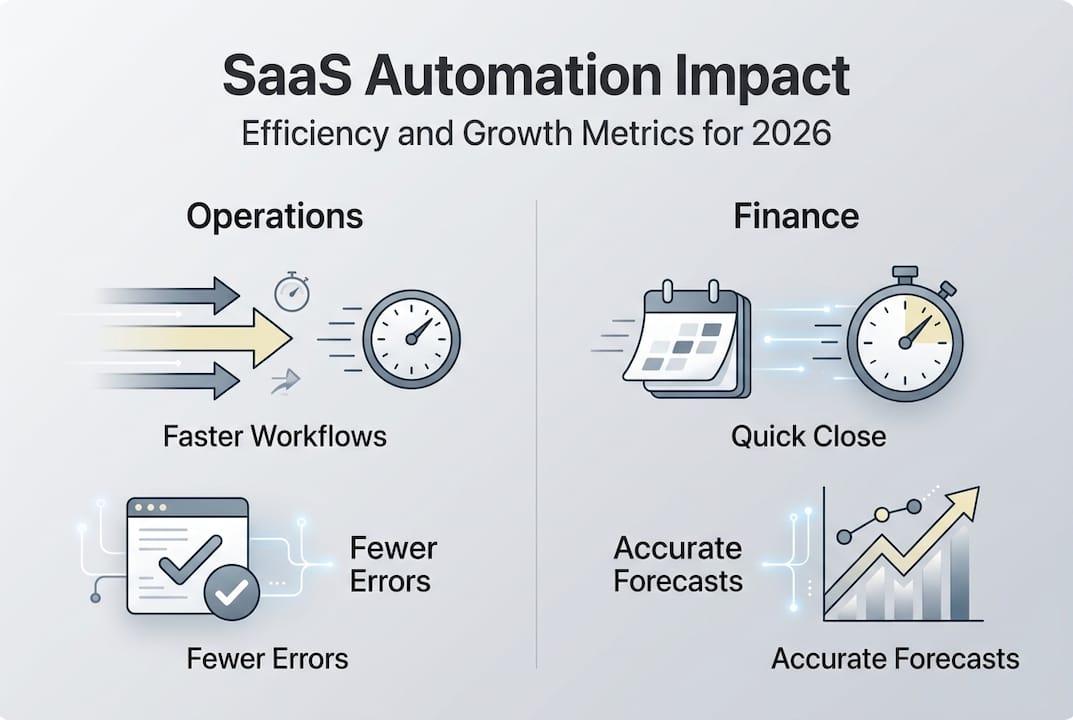
| Faster month end close | Automation reduces month end close by fifty to seventy five percent and saves thirty to fifty hours each month for typical growth stage SaaS firms. |
| Strategic finance shift | Finance teams move from data processing to strategic analysis as automation handles repetitive tasks. |
The operational impact of automation for SaaS companies
Automation fundamentally reshapes how SaaS companies allocate human resources and manage operational workflows. The essential role of automation becomes clear when you examine where your team currently spends time. Most growth-stage SaaS companies dedicate 40-60% of operational capacity to repetitive, low-value tasks like data entry, invoice processing, and manual reconciliations.
Case studies demonstrate that SaaS workflow automation drives measurable efficiency gains. Companies implementing comprehensive automation report 50% improvements in operational efficiency alongside dramatic reductions in manual labor requirements. These gains compound over time as automated systems handle increasing transaction volumes without requiring additional headcount.
The key to successful automation lies in targeting the right processes. Focus on repetitive tasks with clear rules and predictable outcomes. Invoice generation, payment reminders, data synchronization between systems, and standard report generation represent ideal automation candidates. These workflows consume significant time but require minimal human judgment.
Pro Tip: Map your current operational workflows before selecting automation tools. Document every step in processes like invoicing, collections, and reconciliation. This audit reveals bottlenecks and helps you prioritize high-impact automation opportunities that deliver immediate ROI.
“Companies that automated core operational workflows reduced manual labor requirements by 60% while maintaining or improving accuracy levels across all automated processes.”
The operational benefits extend beyond simple time savings. Automation creates consistency, eliminates human error in repetitive tasks, and generates audit trails automatically. Your finance team shifts from data processors to strategic analysts who interpret results and guide decision-making. This transformation proves especially valuable as you scale, since automated systems handle 10x transaction volume without 10x cost increases.
Financial automation: accelerating compliance and month-end close
Financial automation addresses the most time-intensive challenges facing SaaS finance teams: revenue recognition complexity and month-end close processes. ASC 606 compliance requirements create substantial manual work for companies with subscription models, usage-based pricing, or multi-year contracts. Without automation, finance teams spend days reconciling deferred revenue, allocating payments across performance obligations, and ensuring accurate recognition timing.
The SaaS revenue recognition guide explains how automation transforms these processes. Systems that automatically calculate deferred revenue, track performance obligations, and apply recognition rules reduce month-end close by 50-75%. This translates to 30-50 hours saved monthly for typical growth-stage companies.

| Process | Manual Time | Automated Time | Time Saved |
|---|---|---|---|
| Revenue recognition | 20-25 hours | 5-7 hours | 15-18 hours |
| Deferred revenue reconciliation | 12-15 hours | 3-4 hours | 9-11 hours |
| Month-end close | 40-50 hours | 10-15 hours | 30-35 hours |
| AR/AP management | 15-20 hours | 4-6 hours | 11-14 hours |
Key financial tasks that benefit most from automation include:
- Revenue recognition calculations across multiple performance obligations and contract terms
- Deferred revenue tracking and automated journal entries for recognition timing
- Accounts receivable management including invoice generation, payment application, and collections workflows
- Accounts payable processing with three-way matching and approval routing
- Cash flow forecasting based on subscription cohorts and renewal probabilities
The SaaS accounting checklist highlights how automation supports compliance while accelerating close processes. Automated systems maintain detailed audit trails, apply consistent rules across all transactions, and flag exceptions requiring human review. This combination of speed and accuracy proves critical during fundraising, audits, or acquisition processes.
Pro Tip: Implement financial automation in phases starting with accounts receivable. AR automation delivers immediate cash flow benefits through faster invoicing and payment application. Success here builds organizational confidence before tackling more complex revenue recognition automation.
Financial automation also improves forecasting accuracy. Systems that track subscription metrics, renewal rates, and expansion revenue automatically generate forward-looking projections based on actual cohort behavior. You replace spreadsheet guesswork with data-driven forecasts that update in real time as customer behavior changes.
Advanced automation mechanics and business outcomes
AI agents and API integrations power the most sophisticated SaaS automation workflows. These technologies move beyond simple task automation to orchestrate complex, multi-step processes that previously required human coordination. Lead qualification provides a compelling example. Manual qualification processes consume hours as sales teams research prospects, score fit, and prioritize outreach. AI agents reduce this timeline from hours to minutes by automatically analyzing firmographic data, engagement signals, and buying intent indicators.
Empirical benchmarks demonstrate remarkable outcomes. Companies implementing comprehensive automation report 80% operations reduction, 3x throughput, and 156% revenue growth within six months. Win rates doubled from 18% to 36% as sales teams focused on qualified prospects rather than manual research and administrative tasks.
Cash application represents another high-impact automation area. Manual cash application requires matching payments to invoices, handling partial payments, and resolving discrepancies. Automated systems achieve 70% straight-through processing rates by matching payments using multiple data points including amount, customer identifier, and invoice reference. The remaining 30% flagged for human review typically involve legitimate exceptions requiring judgment.
| Metric | Manual Process | AI Automated | Improvement |
|---|---|---|---|
| Lead qualification time | 2-4 hours per lead | 5-10 minutes per lead | 95% reduction |
| Cash application rate | 40-50% automated | 70-80% automated | 50% improvement |
| Sales win rate | 18% average | 36% average | 100% increase |
| Operational throughput | Baseline | 3x baseline | 200% increase |
API integrations amplify automation benefits by connecting billing systems, ERP platforms, and financial tools. When your billing system automatically syncs with your accounting platform, revenue recognition happens in real time rather than through manual journal entries. The scaling SaaS finance process becomes seamless as transaction volumes grow.
Key automation examples across SaaS operations:
- Lead qualification using AI to analyze prospect fit and buying signals automatically
- Cash application matching payments to invoices with 70-80% straight-through processing
- Workflow orchestration connecting billing, accounting, and reporting systems via APIs
- Customer onboarding automating provisioning, welcome sequences, and initial training
- Renewal management triggering outreach based on usage patterns and contract timing
Pro Tip: Monitor AI agent performance closely during initial deployment. Track edge cases where automation fails or produces unexpected results. Maintain human oversight on critical exceptions like large payment discrepancies or unusual contract terms until you validate system accuracy.
The business outcomes extend beyond operational metrics. Automation enables your team to handle growth-stage complexity without proportional cost increases. You maintain lean operations while supporting enterprise-level transaction volumes and customer counts.
Balancing automation benefits with strategic human oversight
Automation delivers tremendous value but requires careful boundaries. Certain tasks demand human judgment and strategic thinking that AI cannot replicate. Understanding where to maintain human involvement protects your competitive differentiation and prevents costly mistakes.
Edge cases reveal automation limitations. Multi-currency reconciliations involving exchange rate fluctuations and timing differences often require human review. Contract modifications mid-term, especially those changing pricing or adding performance obligations, need careful analysis to ensure proper revenue treatment. Usage variances outside normal patterns may indicate data quality issues rather than legitimate consumption changes.
Automate repetitive, low-judgment tasks while preserving human control over strategic decisions. Pricing strategy, contract negotiations, and customer relationship management require nuanced judgment that considers competitive positioning, customer lifetime value potential, and strategic account importance. Automating these functions risks commoditizing your offering and eroding the differentiation that justifies premium pricing.
Risks of over-automation include:
- Tool proliferation creating “Zapier tax” where integration costs scale faster than value delivered
- Workflow fragmentation as point solutions create data silos and require manual reconciliation
- Loss of institutional knowledge when teams no longer understand underlying processes
- Reduced flexibility to handle exceptions or adapt to market changes quickly
- Customer experience degradation when automated responses lack appropriate context or empathy
The automation in SaaS finance approach balances efficiency with control. Automate the mechanics of revenue recognition calculations but maintain human review of unusual contracts. Automate invoice generation and payment reminders but keep collections conversations human-led for high-value accounts. This hybrid model captures efficiency gains while preserving relationship quality.
“Successful SaaS companies automate the repeatable and reserve human talent for high-judgment activities that create competitive advantage and drive strategic value.”
Cost considerations matter too. Automation tools charge per transaction, per user, or based on data volume. As you scale, these costs can grow unexpectedly. Evaluate total cost of ownership including licensing, implementation, maintenance, and integration expenses. Sometimes a partially automated process with human oversight costs less and performs better than full automation requiring expensive enterprise tools.
Pro Tip: Establish clear escalation rules defining when automated processes should flag exceptions for human review. Set thresholds based on dollar amounts, customer segments, or transaction complexity. This ensures automation handles routine cases while experts address situations requiring judgment.
Implementing automation successfully in growth-stage SaaS businesses
Successful automation implementation follows a structured approach that minimizes disruption while maximizing value. Growth-stage companies benefit from phased rollouts that prove ROI before expanding automation scope. This methodical approach builds organizational confidence and allows teams to adapt gradually.
-
Conduct comprehensive operational audit documenting current workflows, time investments, and pain points across finance, sales, and customer success functions. Quantify hours spent on each process and identify bottlenecks causing delays or errors.
-
Prioritize automation opportunities based on impact and implementation complexity. Focus on high-volume, repetitive tasks with clear rules and measurable outcomes. Accounts receivable automation typically delivers fastest ROI through improved cash flow and reduced DSO.
-
Select tools that integrate with your existing technology stack. Evaluate API capabilities, data synchronization frequency, and compatibility with your billing system, accounting platform, and CRM. Native integrations reduce implementation time and ongoing maintenance.
-
Implement phased rollout starting with AR automation including invoice generation, payment reminders, and cash application. Validate accuracy and performance before expanding to additional processes.
-
Integrate billing and ERP APIs early to enable real-time data flow between systems. This foundation supports advanced automation like automated revenue recognition and financial reporting.
-
Monitor exception rates and resolution times continuously. Track which scenarios trigger human review and refine automation rules to reduce false positives while maintaining accuracy.
-
Combine AI automation with human decision-making for strategic activities. Use automation to surface insights and recommendations but maintain human control over pricing decisions, contract negotiations, and customer relationship strategies.
The essential role of automation becomes evident as you progress through implementation phases. Early wins build momentum and justify investment in more sophisticated automation. Your team transitions from skepticism to advocacy as they experience time savings and reduced manual workload.
Pro Tip: Establish KPIs measuring automation success including DSO reduction, FTE hours saved, error rates, and exception handling time. Track these metrics monthly to quantify ROI and identify optimization opportunities. Target 30-40% time savings in first six months of AR automation.
Change management proves as important as technology selection. Communicate automation benefits clearly, address team concerns about job security, and emphasize how automation elevates their roles from data processors to strategic analysts. Provide training on new tools and create feedback loops where team members can report issues and suggest improvements.
The role of automation in SaaS finance evolves as your company scales. Initial automation focuses on tactical efficiency gains. As you mature, automation enables strategic capabilities like real-time financial reporting, predictive analytics, and scenario modeling that inform growth decisions.
How Meticq supports your SaaS automation journey
Implementing effective automation requires both the right tools and strategic guidance. Meticq provides SaaS companies with financial management platforms designed specifically for subscription business models and growth-stage complexity. Our solutions automate core finance processes while tracking the SaaS-specific metrics that drive strategic decisions.
The platform integrates with your existing billing and accounting systems to provide real-time visibility into revenue, cash flow, and key performance indicators. You gain automated dashboards tracking CAC, NRR, LTV, burn rate, and payback period without manual data compilation. This automation frees your finance team to analyze results and guide strategy rather than building reports.
Key features supporting your automation journey:
- Automated metrics dashboards providing real-time visibility into SaaS KPIs and financial performance
- Strategic automation advisory helping you identify high-impact opportunities and implementation roadmaps
- Financial compliance support ensuring ASC 606 revenue recognition accuracy and audit readiness
- Integration capabilities connecting billing, accounting, and reporting systems seamlessly
Meticq acts as your fractional CFO partner, combining automation technology with SaaS finance expertise. We understand the unique challenges of subscription revenue models, deferred revenue management, and the metrics investors scrutinize. Our platform and advisory services help you implement automation in SaaS finance strategically, measuring what SaaS metrics to track at each growth stage.
The SaaS financial planning guide approach we provide helps you leverage automation to improve unit economics while scaling efficiently. You gain the financial clarity and operational efficiency needed to attract investors, manage cash flow confidently, and make data-driven growth decisions.
Frequently asked questions
What key process should growth-stage SaaS companies automate first?
Accounts receivable automation delivers the highest immediate impact for most growth-stage SaaS companies. Automating invoice generation, payment reminders, and cash application improves cash flow by reducing DSO while freeing finance team capacity. This quick win builds organizational confidence in automation and generates ROI that justifies expanding to other processes. Start with AR, validate results, then move to revenue recognition and other automation in SaaS finance areas.
How does automation improve SaaS financial compliance?
Automation standardizes revenue recognition processes ensuring consistent ASC 606 compliance across all contracts and transaction types. Automated systems apply recognition rules uniformly, maintain detailed audit trails, and flag exceptions requiring review. This reduces manual errors that create compliance risks during audits or due diligence processes. The SaaS revenue recognition guide explains how automation makes month-end close faster and more accurate while maintaining compliance.
What tasks should SaaS leaders avoid automating?
Avoid automating complex pricing decisions, contract negotiations, and strategic customer relationship management. These activities require nuanced judgment considering competitive positioning, customer lifetime value potential, and market dynamics. Automating strategic functions risks commoditizing your offering and eroding differentiation that justifies premium pricing. Maintain human involvement in high-judgment areas while automating repetitive, rules-based processes. The automation in SaaS finance approach balances efficiency with strategic control.
How long does it take to see ROI from SaaS automation?
Most growth-stage SaaS companies see measurable ROI within 60-90 days of implementing accounts receivable automation. Time savings appear immediately as systems handle invoice generation and payment application automatically. Cash flow improvements from reduced DSO typically materialize within the first billing cycle. More complex automation like revenue recognition may take 90-120 days to fully implement and validate, but delivers ongoing benefits that compound as transaction volumes grow.
What metrics should SaaS companies track to measure automation success?
Track DSO reduction, FTE hours saved, error rates, exception handling time, and month-end close duration. These metrics quantify automation ROI and identify optimization opportunities. Target 30-40% time savings in automated processes within six months. Monitor exception rates to ensure automation maintains accuracy while handling increasing volumes. Cash flow improvements from faster collections and reduced manual processing costs provide additional ROI validation beyond time savings.